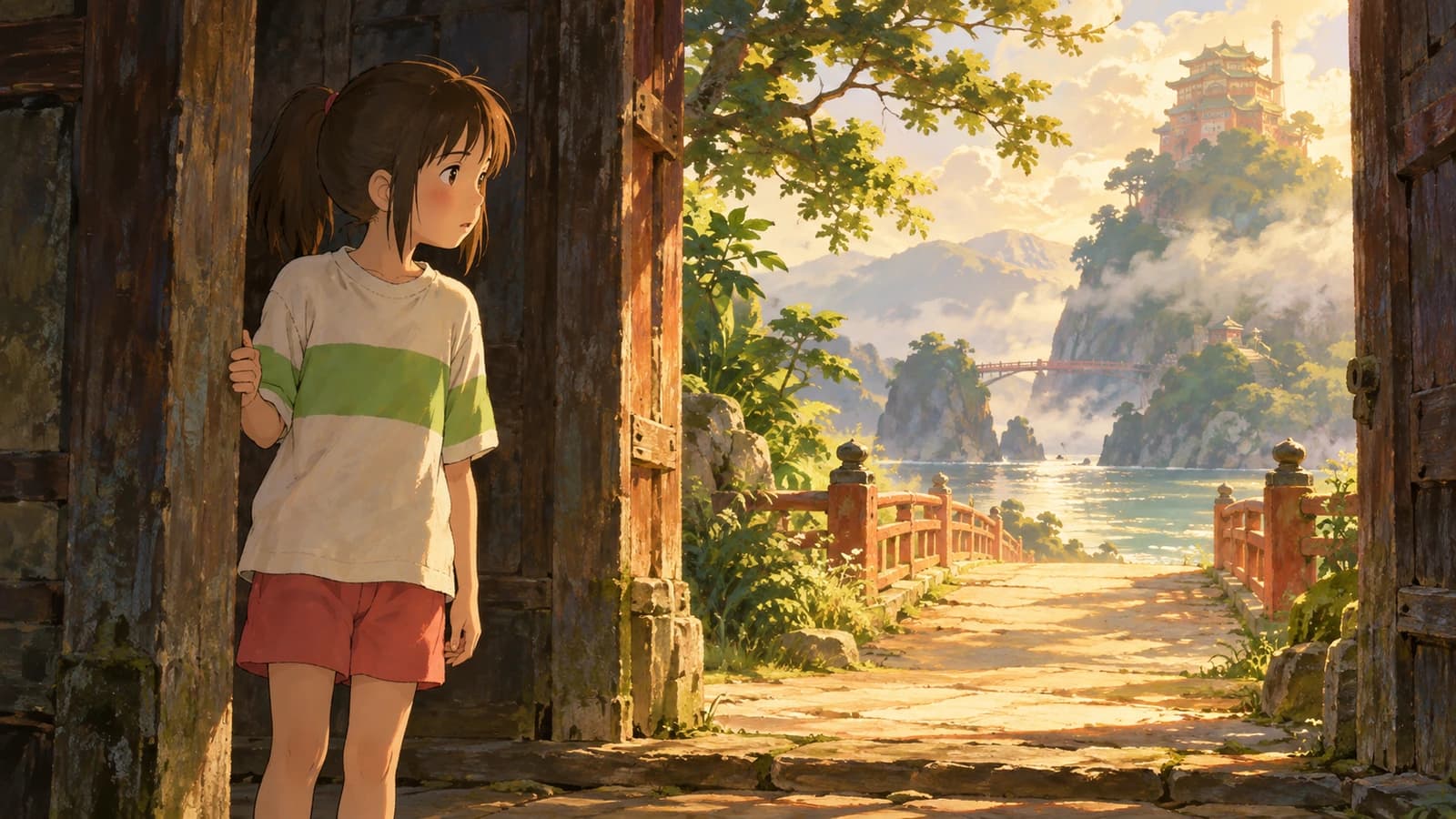
Spoiler note: This article discusses Chihiro’s parents, Haku’s injury and the train journey later in the film.
Chihiro doesn’t arrive in the spirit world sounding like somebody who knows what she’s doing. That’s part of the pleasure of following her: composure has somewhere to go.
But the work behind that voice is easy to miss. A Japanese-language interview with Rumi Hiiragi, who voices Chihiro in the original film, offers a way into that work. A Japanese publisher’s sample adds another perspective, from novelist Tomihiko Morimi.
Specific details make Chihiro’s effort easier to hear; a clearly attributed reading makes her journey worth reconsidering. Hiiragi’s account is a recollection published in 2023, not a recording-session transcript. Morimi’s reading is interpretation, not a statement of Miyazaki’s intentions.
Her audition began with confusion, not a complete picture of Chihiro
Hiiragi recalls submitting a cassette recording without an interview. She had little information about the story, so she worked from the lines she’d been given rather than from a detailed understanding of the film. 1
That’s a revealing starting point for this particular heroine. The audition wasn’t, in Hiiragi’s telling, a demonstration of everything Chihiro would eventually become. It began with an unsettled child’s reactions.
We shouldn’t turn that coincidence into a casting theory. The interview doesn’t establish why Miyazaki chose her. Still, it offers a good way into the performance: listen for a person responding before she can explain what’s happening.
The voice came from awkwardness, reactions and a reason to help
Hiiragi says Chihiro’s clumsiness reminded her of herself, helping her perform naturally. The script also gave her punctuation-heavy passages to turn into sounds. For a fall, she imagined her own reaction. 23
She recalls another obstacle: she didn’t know engacho, so Miyazaki explained the expression and gesture. That’s one performer’s experience, not evidence that all Japanese children were unfamiliar with it. The interview doesn’t establish the expression’s history. 2
And the director’s guidance, as she remembers it, was practical: Chihiro was trying hard to help her parents and Haku. That account gives the effort a purpose. It doesn’t prove Chihiro was based on Hiiragi, or supply a secret code for the screenplay. 2
Together, these details make the performance worth hearing closely: the sound before a complete sentence, the difficulty of an unfamiliar word, the urgency of wanting to help. Those are listening suggestions, not additional production facts.

Her later voice was re-recorded to sound more assured
The most striking detail comes near the end of the interview. Hiiragi recalls returning roughly a month before release to re-record the stretch from Chihiro helping the injured Haku through the ending. She reports that Miyazaki wanted a more assured voice in the later part to communicate Chihiro’s growth. 3
The Japanese description shouldn’t be flattened into “a deeper voice.” Assurance isn’t the same thing as pitch, and this account doesn’t say the whole film was re-recorded.
For a rewatch, it’s a useful listening question: how does Chihiro sound when she’s trying to act, compared with when she’s first trying to understand? You don’t have to treat every difference as a documented directorial instruction. The retake account simply gives you a reason to pay closer attention to the voice.
A Japanese novelist reads the train ride as a second journey
In the opening illustrated section of Ghibli’s Textbook 12: Spirited Away, Morimi presents Chihiro as taking two journeys. First she enters the bathhouse world; later she goes onward by train after establishing a new reality there. 4
This is a novelist’s reading, not a production fact. Its value is the change of perspective it invites. Instead of treating the train ride only as a quieter interval, consider what it means to leave a place after learning how to exist within it.
You don’t have to agree with Morimi to find the question useful. A good interpretation gives you something to test against the work, rather than asking you to accept a hidden answer.
Chihiro can be frightened, awkward and determined without those qualities cancelling each other out. These sources offer ways to listen and questions to carry into another viewing.
On the next viewing, listen before you look for a secret. There’s plenty to notice in how she gets through the next moment.
Sources
1 Nana Naka, interview with Rumi Hiiragi, Bunshun Online, January 6, 2023, page 1: https://bunshun.jp/articles/-/59910
2 The same interview, page 3, script, director-advice and engacho answers: https://bunshun.jp/articles/-/59910?page=3
3 The same interview, page 4, performance and re-recording answers: https://bunshun.jp/articles/-/59910?page=4
4 Ghibli’s Textbook 12: Spirited Away, Studio Ghibli and Bunshun Bunko editors, 2016, ISBN 9784168120114. Official publisher sample, opening Tomihiko Morimi section; sample images 2 and 9, printed page numbers not visible: https://books.bunshun.jp/list/browsing/9784168120114