
A page can show a second stretched across several panels, or years passing between two pictures. You can read a large image quickly and spend much longer studying a small one.
That flexibility is one of the pleasures of comics. Unlike a normally playing film, a printed page does not advance on a fixed clock. It arranges opportunities for your attention, and you supply the movement between them.
To understand its pacing, it helps to separate two questions: how much time passes in the story, and how long you spend reading what the page offers.
One action can become several beats
Imagine a simple event: a character reaches for a cup and finds it empty. A single panel could communicate the discovery. A sequence could instead show the hand approaching, the cup lifting, the character looking inside, and a final reaction.
The second version has not necessarily added much fictional time. It has divided your attention into smaller steps.
In his drawing guide, comic artist Steve Ellis describes paneling as a way to decide which stages of a progression deserve separate images. His guide also explains how additional panels can draw attention to steps that a shorter sequence leaves unseen. 1
That is not a command to use more panels. The choice depends on what makes the event interesting. A delayed discovery might be funny; an immediate discovery might keep the story moving.
A large panel is not a stopwatch
It is tempting to treat size as a simple rule: large panels are slow, small panels are fast. Actual reading is more flexible.
A large, uncluttered image may communicate immediately. A small panel filled with dialogue, unfamiliar objects, or a subtle expression may require more attention.
Size can offer emphasis or room to look, but it does not force every reader to linger for the same duration. The surrounding sequence helps determine what that space means.
An invented page might use several small panels for a repetitive task, then open into one wide view. The change can feel like release because of the established rhythm. Without the earlier sequence, the same wide view may have a different effect.
The gap is part of the sentence
The gutter separates one panel from another, but it also asks you to connect them. You infer what happened between the selected moments.
Ellis’s guide treats gutter width and the presence or absence of borders as additional tools for shaping transitions. 1 Those are possibilities, not a universal code in which a particular gap always equals a particular duration.
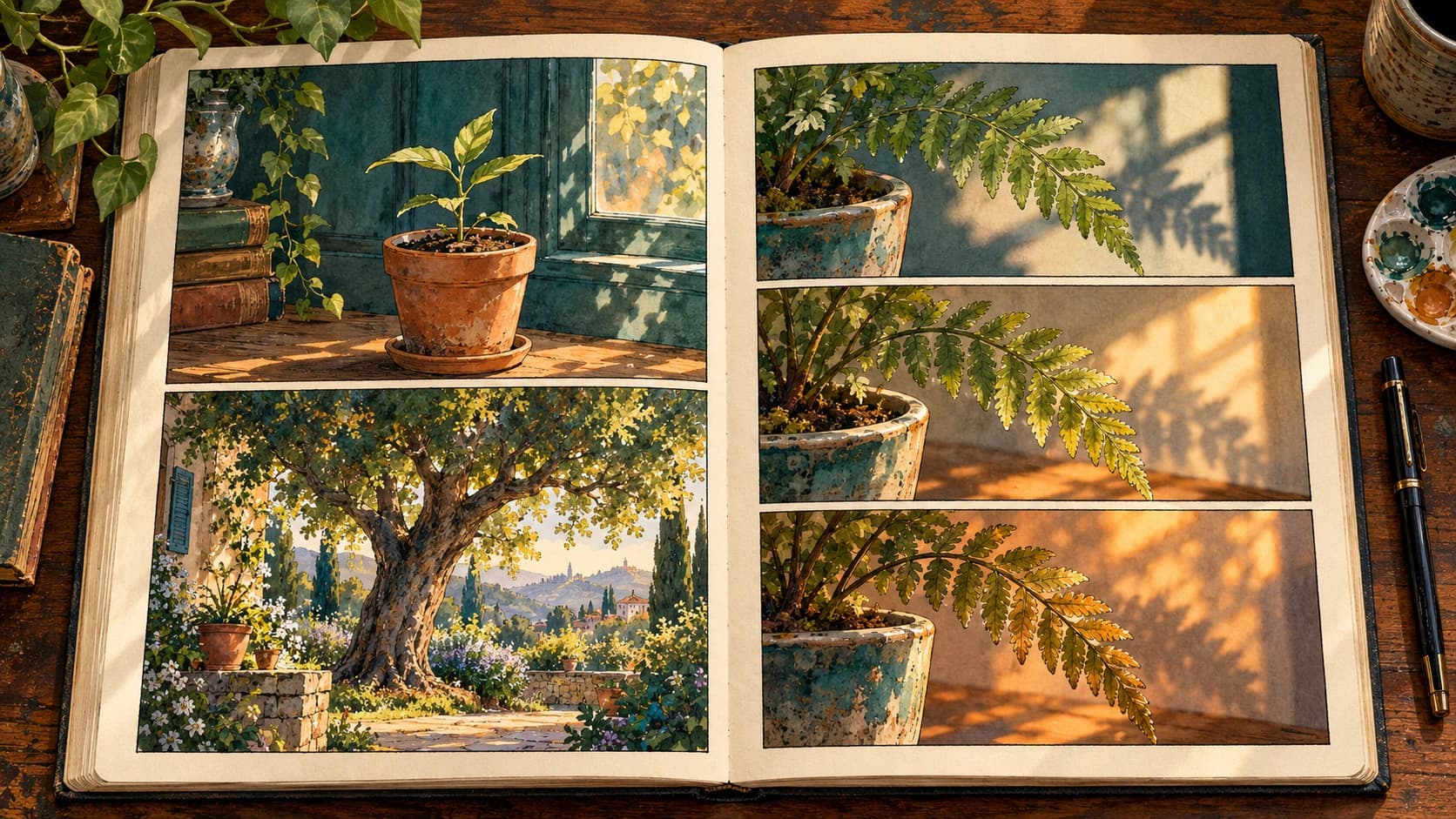
Consider two hypothetical images: a child plants a seed; a tree fills the next panel. The gap could imply years, even if it is physically narrow. The depicted change supplies the duration; the gap’s width alone cannot.
The page has omitted a process while preserving a relationship. Much of the pleasure of reading comics comes from making that connection without needing every intermediate event drawn.
Words add a second route through the page
Speech and captions do not simply sit on top of the pictures. They guide the order in which information arrives.
Letterer Todd Klein explains how balloon placement can lead a reader across a page, especially when panel arrangements become less conventional. His examples are grounded in English’s left-to-right reading pattern. 2
For a reader, this means that pacing involves both the image sequence and the verbal sequence. A reply can arrive within the same panel as a question, or it can be delayed until the next one. Each arrangement makes a different invitation.
Reading direction also matters. Do not impose an English-page expectation on a manga edition that uses a different order. Follow the reading direction established by that edition, including its panel and balloon order.
Stillness can be an event
Not every panel needs a new physical action to earn its space. A repeated view can reveal a changed expression, a longer wait, or the absence of an expected response.
Imagine three panels showing someone waiting beside a door. In the first, they stand upright. In the second, they glance away. In the third, their posture relaxes. The door may remain closed throughout, but the sequence has still developed.
The interest lies in the change of attention or expectation. A reader may feel the pause without being told how many seconds passed.
This is a useful way to discuss quiet pages without calling them empty. Ask what the repeated image lets you compare.
The whole page can arrive before its details
A comic offers a page as a visible arrangement, not only as a sequence consumed one unit at a time. A prominent image may catch your eye before you reach it in the intended order.
That creates a tension between looking and reading. You might sense the shape of a reveal before understanding its context. Or a page turn may protect information until the next surface becomes visible.
When examining pacing, ask what the page lets you glimpse early and what it withholds. Do not judge every effect as though the reader sees one isolated panel at a time.
You can try this with a page you already own: read it normally, then return and notice the order in which your attention moves. Which moment felt extended? Which transition asked you to supply the most?
The answer will not necessarily be the same for every reader. The page proposes a rhythm without locking you to a playback speed.
A comic gives you selected moments and a route between them. Its rhythm lives in the relationship between what is drawn, what is written, what is omitted, and how you move through it.