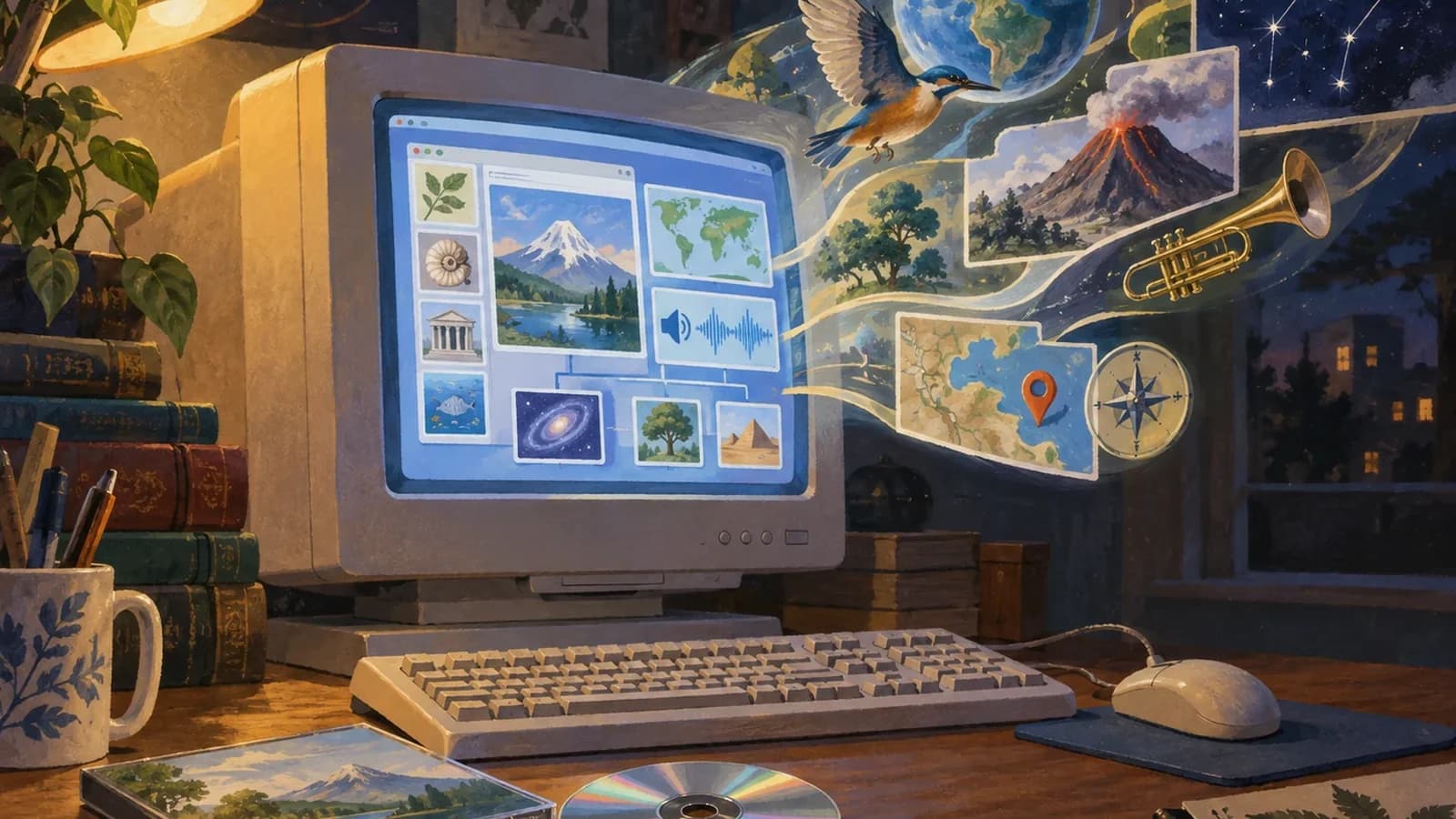
Imagine sitting at a home computer in the 1990s with a straightforward homework question. You open an encyclopedia to look up volcanoes. A related entry leads to a map, the map suggests another place, and a sound button offers something worth hearing. The question that brought you here has not disappeared, but it is no longer the only reason to keep clicking.
That is a hypothetical visit, not a claim that everybody remembers the same software. It gets at what made a multimedia encyclopedia different from simply putting a reference book on a screen. Printed encyclopedias already held an extraordinary quantity of information. The disc changed the route through it—and the little actions available along the way.
Looking something up could become an excursion inside a small, self-contained world.
The disc had room for more than text
The storage advantage was substantial. The Computer History Museum dates Grolier’s Electronic Encyclopedia to 1985, calling it the first general-interest CD-ROM product. Its nine million words used only part of the disc’s capacity. The museum describes an early CD-ROM capacity of 550 megabytes; that is a specific historical figure, not a capacity shared by every later disc. 1
Those facts establish room for expansion, not the existence of a particular sound or animation in that first encyclopedia. The distinction matters. A disc can hold multimedia without every title making the same use of it.
The museum’s account of networking and the web describes affordable CD-ROM drives enabling a range of multimedia publications in the late 1980s and early 1990s, including reference works with hypertext links. 2 Text, pictures and recorded material could become parts of one navigable package rather than separate objects a reader had to assemble.
Microsoft’s company chronology records Encarta’s availability on March 22, 1993 and promotes it as an encyclopedia designed for a computer. 3 That is Microsoft’s description of its product, not independent proof that it invented multimedia reference publishing. For a reader, the useful question is more concrete: what could the interface let you do with an entry?
A lookup did not have to be a straight trip
A shelf of reference books gives information a physical geography. You choose a volume, turn to an entry and follow a cross-reference to another location. Browsing is possible there too; printed reference works did not have to wait for a computer to become interesting.
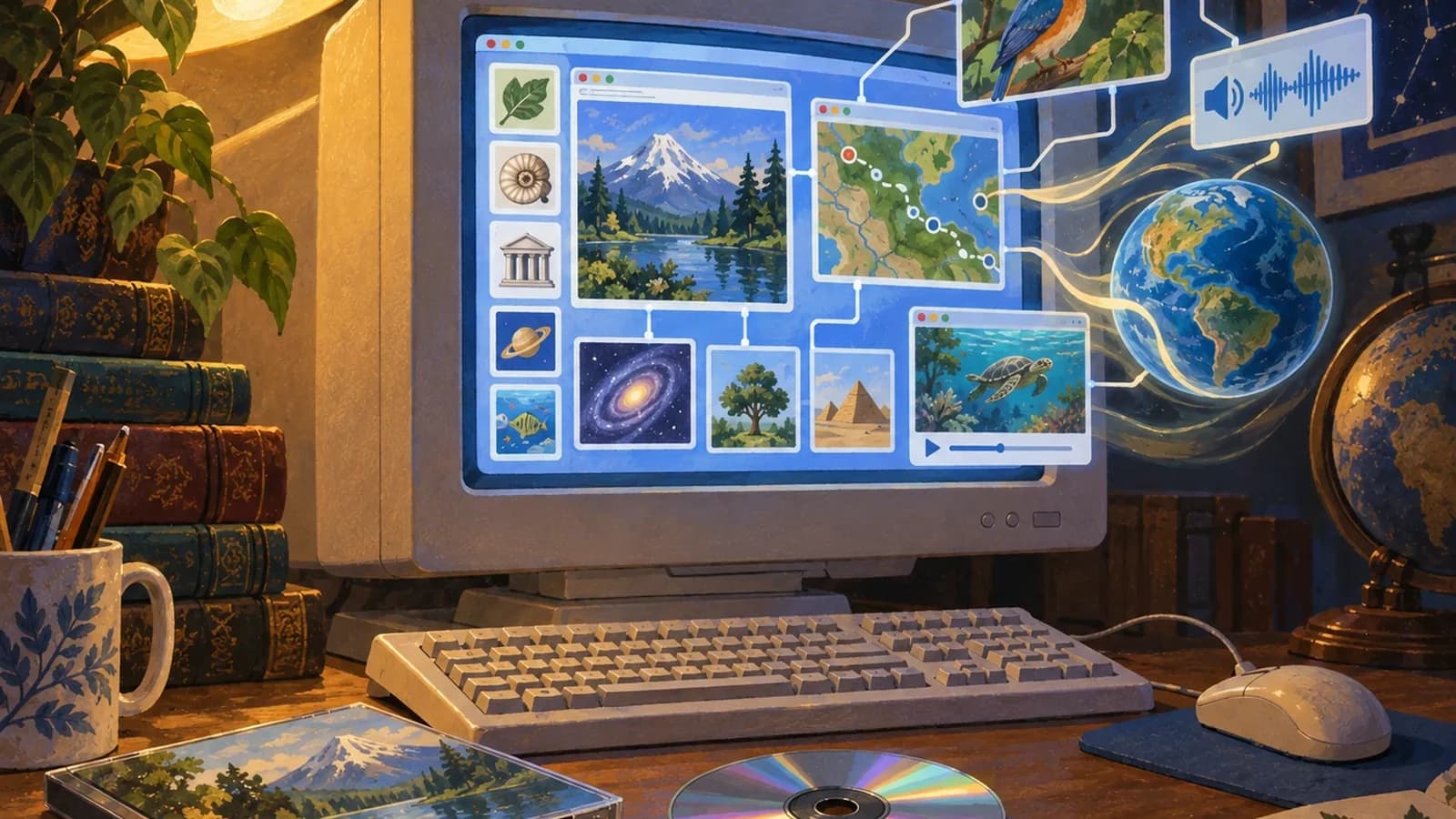
On a disc, a search box or linked phrase offers a different route. Moving from a person to a place to an event need not involve remembering which volume contains each subject. The connection itself becomes something you can act on.
Microsoft’s September 1996 announcement made room for both purposeful searching and casual browsing. It described Encarta 97’s two encyclopedia editions as containing more than 31,000 articles. The Deluxe edition used two discs, but duplicated the searchable text on both to reduce disc swapping; the media were arranged by topic and activity. 4
That design decision is revealing. More material is not automatically a better excursion when every turn interrupts it. Repeating the text traded some space for continuity: a reader could keep following the written trail without every change of subject necessarily becoming a request for the other disc.
Multimedia gave an entry something to do
The same 1996 announcement described photographs, audio, maps, videos and animations in the encyclopedia line. 4 The attraction was not merely a longer checklist of formats. Each offered a different possible relationship with the subject.
Consider an instrument. A paragraph can describe its tone, and a photograph can show its construction. A recording adds a way to hear it. Or consider a place: a written description and a map answer different questions, even when both sit beside the same entry.
These are illustrative comparisons, not an inventory of a particular edition. Nor does a button automatically improve an explanation. A tiny video can show less than a carefully chosen still image; an attractive animation can distract from the point it was supposed to clarify.
The interesting change is that the reader has a choice of actions. Read, play, enlarge, follow, return. In that sense, an encyclopedia can invite a kind of play without needing a score, a competition or a claim that every title was a game. Curiosity has something to operate.

A finite collection can still feel expansive
The offline contents of a disc have an edge. They were selected, organized and shipped as a package. Following a link within that collection is different from being sent to an unrelated site with a different design and a new set of assumptions about what you came to do.
That boundary can be restrictive. An entry cannot anticipate every question; a shipped disc cannot silently contain tomorrow’s discovery. Yet a finite collection can also make wandering feel coherent. You can lose track of your original question without losing track of the object you are exploring.
Picture the hypothetical volcano lookup again. A map leads sideways, an unfamiliar term offers another entry, and a recording catches your attention. The sense of discovery comes from the route, not from a claim that the collection contains everything.
A bounded reference work and an open web therefore offer different pleasures. One is not simply a smaller, worse version of the other. Their edges change what a detour feels like.
The boundary was not permanent
Disc-based does not mean permanently disconnected. Encarta 97 also offered Web Links and online yearbook updates; the 1996 announcement presented them as ways to extend research beyond the CD-ROM. 4 The particular edition and its online services matter when describing where that boundary sat.
By October 2000, Microsoft was announcing an expanded Encarta.com with a search service and additional educational resources. 5 This is a dated product announcement, not a claim that the old service remains available today.
The Computer History Museum describes hypertext-linked CD-ROM content as well suited to being carried onto the web. 2 The navigational habit did not need to disappear with the physical package: start with a subject, follow an association, encounter another form of explanation, then move sideways again.
What makes the old disc worth thinking about is not a simple story of better times or obsolete machinery. It is that particular combination of possibility and enclosure. There could be enough to explore without the next click opening onto the entire internet.
A highlighted phrase, a map or a speaker button could turn retrieving an answer into trying something. The encyclopedia still had edges. Within them, looking up one thing could become a reason to see what else happened when you clicked.