A new location can give a familiar character a new wardrobe. The revealing detail may be what changes—or the habit that survives the change.
In Glass Onion: A Knives Out Mystery, costume designer Jenny Eagan described Benoit Blanc’s knotted kerchiefs as a continuation of the floral ties he wore in the earlier film. In her Netflix interview, she connected the new clothes to a version of the character on vacation, and discussed the ideas Daniel Craig brought to their fittings. The account gives us a documented link between a design choice, an actor’s understanding, and continuity across settings. 1
You do not need the mystery’s solution to find that interesting. A wardrobe can tell us that circumstances have changed while preserving a recognizable way of presenting oneself. The clothes are new; the habit of being that person has not entirely disappeared.
Clothing can be a pattern rather than a code
It is tempting to read costume through a quick dictionary: a dark coat means danger, a bright color means confidence, an expensive-looking jacket means authority. Those interpretations can be convenient. They can also ignore the scene, the culture, and the person wearing the clothes.
A more useful question is comparative. Does this character dress differently from the people around them? Do they repeat an item when everyone else changes? Does a garment seem chosen for the setting or carried into it from another part of their life?
These are observations about relationships. They do not require a universal meaning for a color or fabric. A formal jacket could be comfortable routine for one character and conspicuous effort for another. The film needs to supply the context that makes either reading persuasive.
The example from Eagan’s account is valuable precisely because it has attribution. We do not have to invent a reason for the kerchiefs and then announce it as production history. We can distinguish her explanation from our own response to the result.
Begin with what a garment allows
ScreenSkills’ costume-designer skills checklist includes script analysis, research, working with performers, fittings, and coordinating the realization of designs. Costume is not simply selecting an attractive object and placing it in front of a camera. The garment has to participate in a production and a performance. 2
For a fictional scene, imagine a character entering a crowded room in a coat they cannot easily remove. The coat may become part of the action: a sleeve catches, a bag has to be passed to someone else, a greeting is delayed. Another coat would make the entrance physically different.
That does not mean the inconvenience automatically represents emotional discomfort. It might be practical comedy, awkward weather gear, or an incidental movement. Start with what the garment makes possible before assigning it a psychological message.
A pocket, fastening, cuff, or collar can give an actor something to handle. Whether that gesture reads as nervous, habitual, or deliberate depends on the performance around it. Costume and acting meet in those small actions.
A repeated item makes change visible
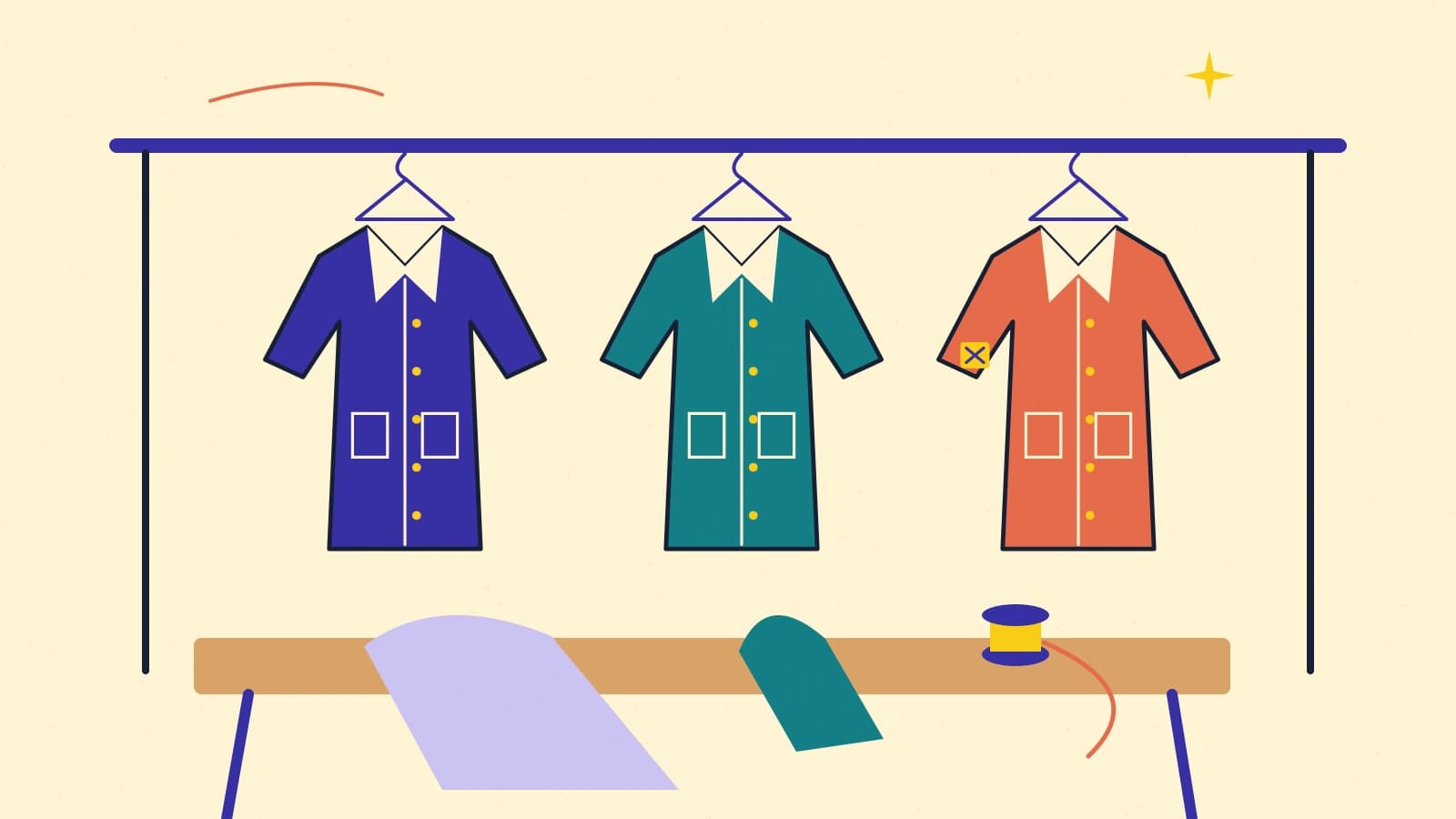
Imagine an invented character who wears the same indigo jacket in three scenes. First it is buttoned carefully. Later it hangs open over different clothes. Finally, it has been repaired at the cuff.
The repeated jacket gives us a stable object through which to notice differences. The repair might suggest attachment, necessity, pride in maintaining things, or a story we have not yet learned. It does not prove any one of them.
This is why repetition can be more revealing than constant novelty. If every scene introduces an entirely unrelated outfit, each look must establish itself afresh. When something returns, viewers can compare it with their own memory.
The comparison may also be less obvious than a damaged sleeve. Perhaps a character stops adjusting a collar that previously occupied their attention. The same garment can participate in a different performance. A costume discussion that catalogs only colors and brands could miss the most interesting change.
Fit belongs to the image and the movement
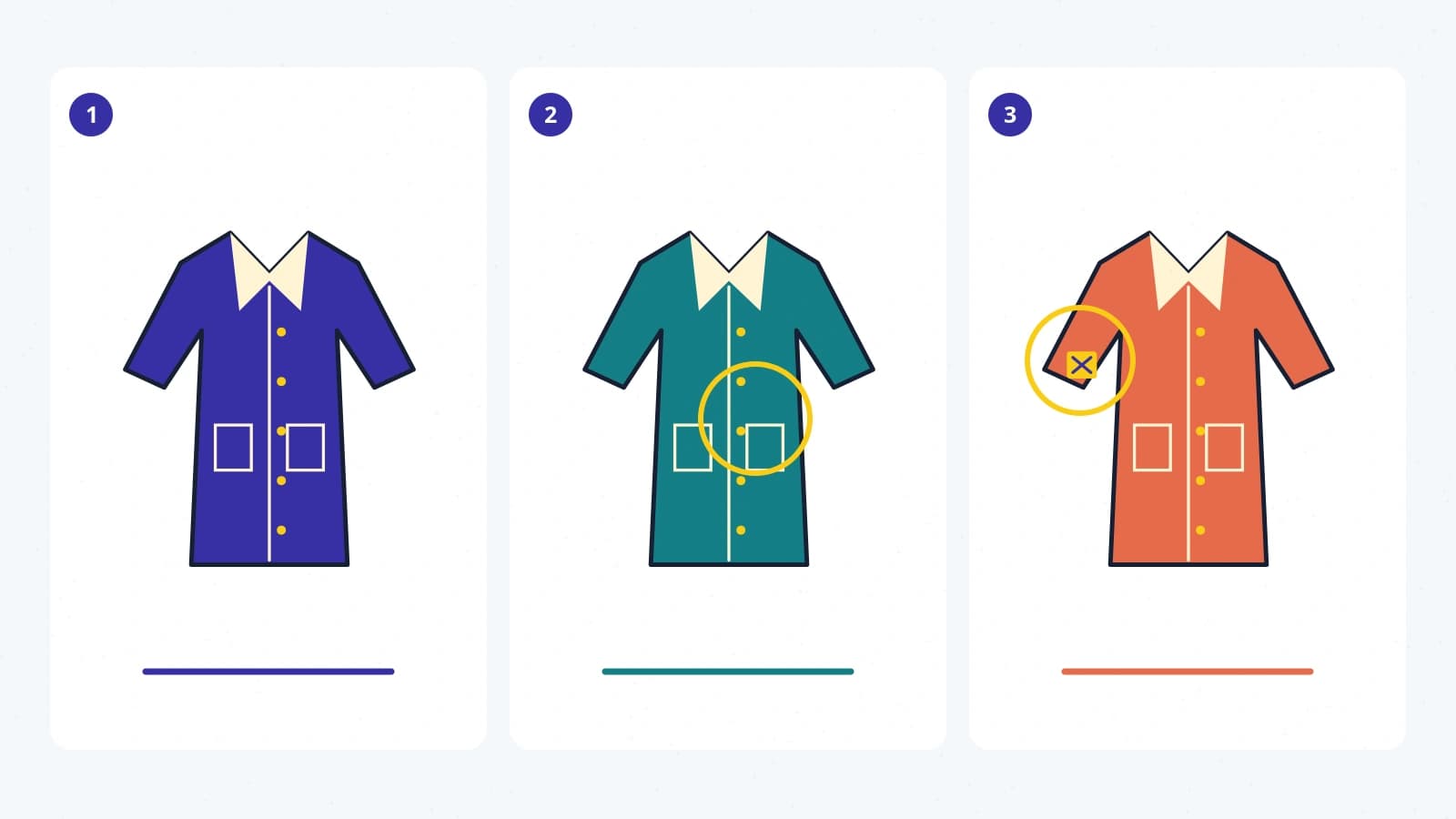
Consider three hypothetical versions of a coat: sharply fitted, loosely draped, and slightly restrictive across the shoulders. They could create different outlines and different movement. That does not tell us which is flattering or which body is desirable. It tells us that fit is one of the materials through which a screen performance is made.
A loose shape may conceal a gesture until a hand emerges. A crisp edge may make a turn look more decisive. A restrictive piece may alter the way a performer reaches or sits. These are possibilities to examine in a specific scene, not automatic character diagnoses.
The supporting illustration for this article uses invented garments rather than copies of a film costume. It separates three kinds of observation: silhouette, construction detail, and evidence of use. None is labeled a personality trait.
That separation matters beyond careful criticism. Clothes in entertainment can invite enthusiasm without turning a person’s appearance into a verdict about their worth, morality, or social identity.
Do not mistake every detail for a secret clue
A mystery makes this temptation especially strong. Once you expect clues, a button can begin to look like a confession. But a costume also has to support ordinary continuity, movement, and the visual world of the film.
An element can be aesthetically effective without being a puzzle for the audience to solve. It can also have several jobs. A recognizable accessory might establish continuity, enliven a composition, and give an actor a gesture. None of those functions cancels the others.
The appropriate claim depends on the evidence. “The same accessory returns” can be checked by inspecting the relevant scenes. “The designer describes it as an extension of an earlier look” can be supported by an interview. “It foreshadows the ending” requires a different argument—and may cross a spoiler boundary that an introductory article should preserve.
This piece discusses published costume-design explanations and fictional exercises. It does not decode plot revelations or claim that every garment in the cited film was independently inspected.
Follow one detail through a familiar film
On a later viewing, choose an ordinary category: footwear, outerwear, fastenings, or something a character repeatedly handles. Do not try to inventory the entire wardrobe. Notice when the detail appears, whether it changes, and what the performer does with it.
Then ask whether the observation supports a modest interpretation. Perhaps a repeated item makes a changed setting feel connected to an earlier one. Perhaps a garment becomes less noticeable as a character grows comfortable. Or perhaps the detail remains pleasing without becoming narratively significant.
An interpretation does not need to uncover a hidden master plan to be worthwhile. It can simply help you see a performance more fully. The strongest discussions leave room for the designer’s documented account, the actor’s choices, and the viewer’s own experience without pretending those are identical.
Costume can announce a character, but it can also sustain one through change. Sometimes the most revealing wardrobe decision is not a spectacular new look. It is the familiar detail that finds a way to travel with its wearer.