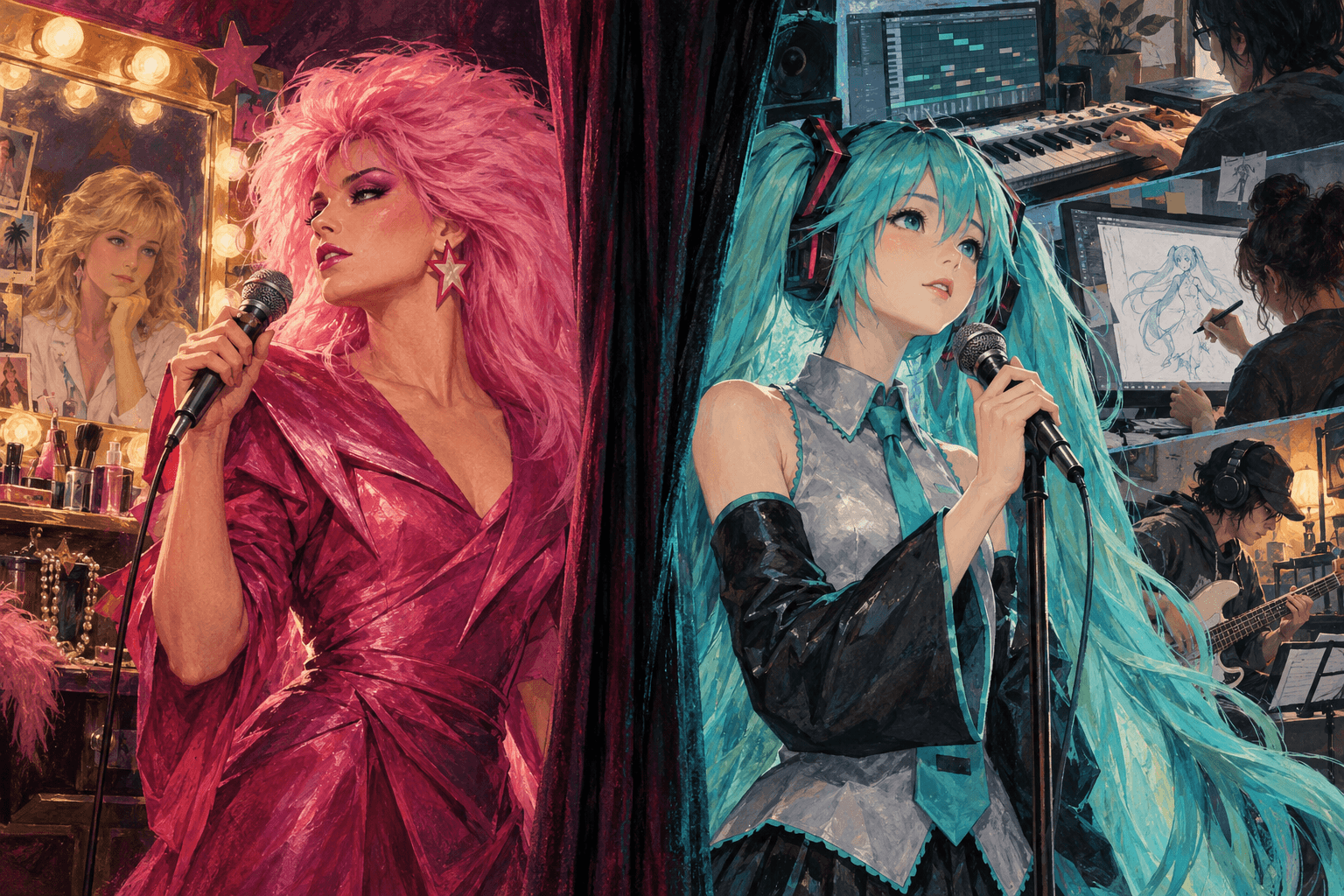
Jem has a problem most singers would envy: her disguise makes her more famous. Jerrica Benton, the woman who becomes the pink-haired frontwoman of the Holograms, isn't trying to disappear into a crowd. Her computer, Synergy, supplies a public self designed to command one. The ordinary logic of concealment has been turned inside out. To keep a secret, she has to become spectacular.
The complications are wonderfully inconvenient. Rio can be drawn to Jerrica and to Jem without understanding that he is responding to the same woman. A love triangle becomes an argument a person can have with her own image: which version of me do you think you love? Christy Marx, who developed the animated series for Sunbow, has identified that triangle as one of her contributions. The technology provides the disguise; the hurt feelings give it something to do.
Hatsune Miku seems, from a distance, to belong to the same family. Here is another brightly colored singer whose appearance depends on technology, this time with turquoise twin tails rather than a pink mane. It is tempting to draw a line from one to the other and congratulate a cartoon on predicting the future. Their documented beginnings don't establish that line. The more interesting connection emerges when we ask who is doing the singing.
With Jem, the story sends us back to Jerrica. With Miku, the first answer is Saki Fujita, the Japanese voice actor whose recordings supplied the original voice material. But that answer immediately needs another. Who wrote this song? Who shaped this phrase? Who drew the face, built the model, made the hair move? Follow Miku backstage and the cast keeps growing.
Two voices for one woman
Jem was already a collaborative illusion long before Miku arrived. Samantha Newark performed the dialogue for Jem and Jerrica; Britta Phillips supplied Jem's principal singing voice. Newark has described the separation: the music and singers were handled in New York, apart from the dialogue operation. The woman an audience heard speaking and the woman it heard singing didn't have to occupy the same studio, let alone the same body.
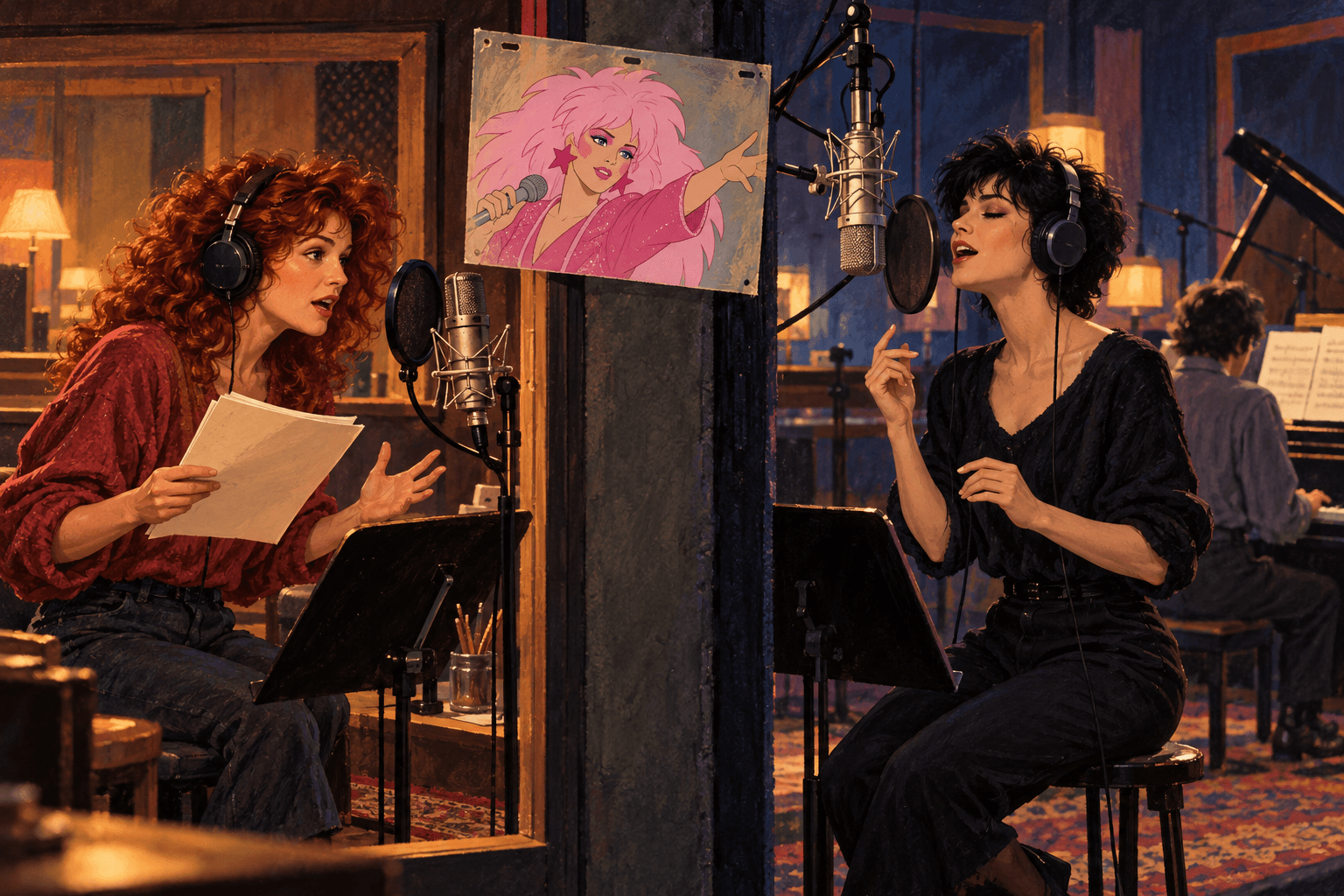
That division seldom troubles the experience of the character. We accept that the person who has just spoken is the person who now sings, because the drawing and the story hold her together. Animation lets a production assemble a person out of performances and then lets us forget the assembly.
Even the singing voice was the endpoint of several people's choices. Composer Anne Bryant recalled arranging and producing the music, alongside the songwriting work she did with Ford Kinder and other collaborators. Phillips, in a later interview, remembered learning songs at the piano with Bryant and Kinder, who explained what was happening to the characters. Emotion had to pass from a dramatic situation to a composition to a singer before it could appear to belong to Jem.
The usual description of the show as a device for selling dolls is useful, up to a point. In an interview, Marx carefully separated the underlying toy concept from her own work. Hasbro had the property and doll prototypes; Sunbow commissioned the animation; she developed identities, personalities, relationships, backstory, and institutions including Starlight Music and the Starlight Girls. Commerce supplied the assignment. Writers still had to make a world worth entering.
The singular star was the elegant result of all this plural labor. Inside the fiction, one woman could account for Jem. Outside it, there were scripts, songs, sessions, drawings, and people whose names were much less conspicuous than the pink hair.
Miku would make some of those seams part of the invitation.
A singer you could write for
The important object in Miku's early history is a software package. Crypton's original Japanese product page offered a voice built around Fujita's recordings and a character illustrated by KEI. A user entered notes and Japanese lyrics, then adjusted elements of the performance. Miku could sing something her voice provider had never sung as a complete song.
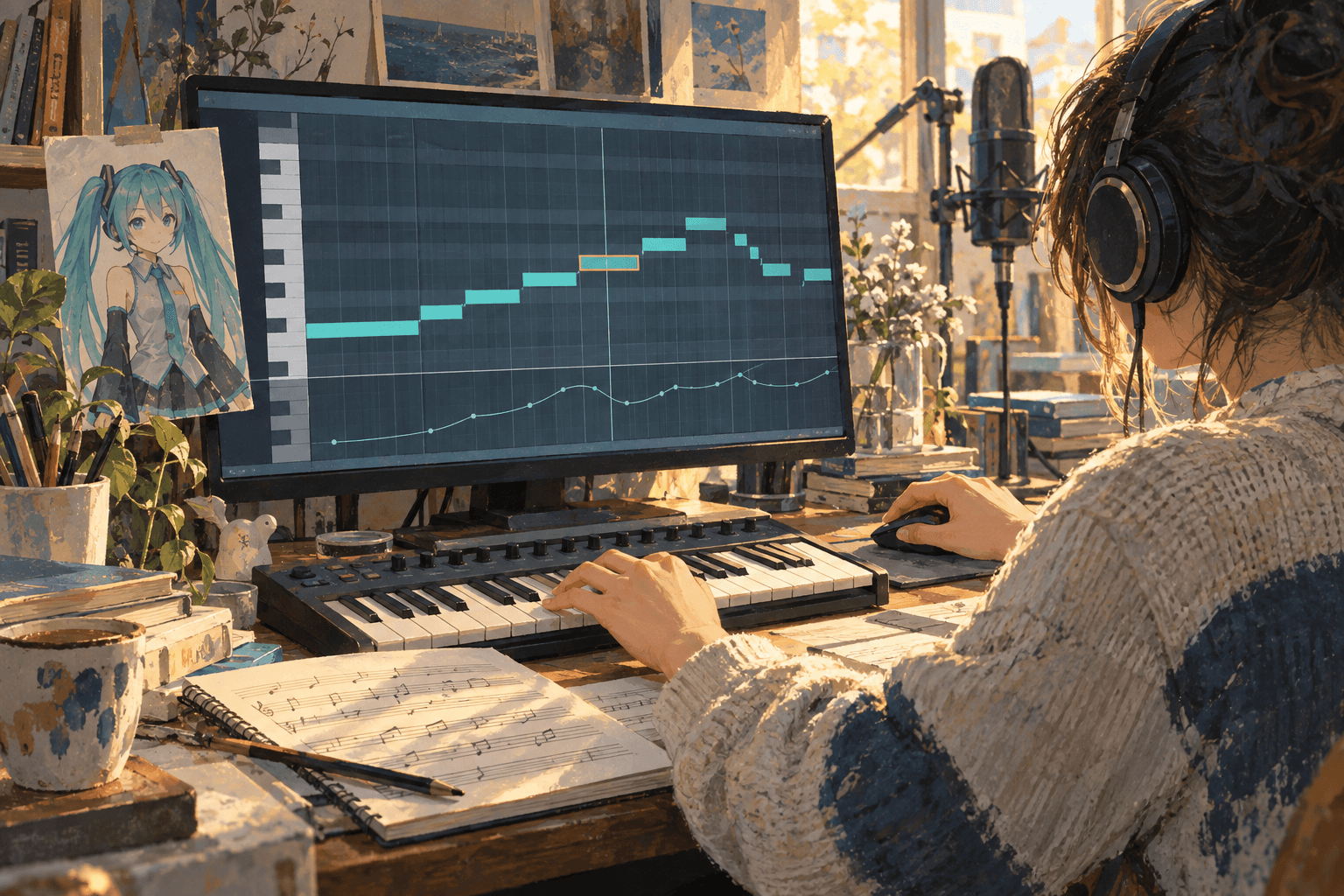
A doll and a singing program can both prompt invention. Their invitations are different, though. A Jem doll gives its owner a performer to imagine stories around. Miku's software gives a music maker a vocal part to construct. The character on the box is also a way into the recording.
Fujita recognized the distinction almost immediately. At an Akihabara event in December 2007, she described listening to Miku as hearing a singer that had developed from her recordings, rather than simply hearing herself sing. Her voice had provided essential material. Other people's work could take it somewhere she hadn't performed.
The distinction still matters when newer tools use machine learning. Yamaha's announcement for Hatsune Miku V6 describes generated singing whose pitch, volume, vibrato and accents remain editable. A system can do more of the work of shaping a vocal line without becoming the songwriter. The name on the software doesn't settle the authorship of the music.
Sometimes the credits are the clearest account of the star. Sony's supercell history lists ryo as producer and Hatsune Miku as vocalist for “World Is Mine,” with illustration and video by redjuice. For “Black★Rock Shooter,” the visual credit goes to huke. Miku makes the works recognizable as connected without making their creators interchangeable.
Nor does each song have to become another chapter in one authorized life. In July 2008, Crypton's Wataru Sasaki explained that he wanted to avoid fixing Miku's image too firmly, leaving newcomers room to create. Users were extending her world through music, pictures, animation, and derivative characters. An incomplete biography could protect a possibility: your song didn't have to arrive after all the important decisions about its singer had already been made.
For a continuing television character, contradiction usually creates a problem that a writer must solve. For Miku, different works can sustain different versions of the person we imagine hearing. She can belong to the emotional world of a song without that song acquiring the authority to explain every other Miku.
That is a useful difference from Jem, whose secret depends on the persistence of the woman underneath. It doesn't make either model more authentic. Jerrica offers the intimacy of a returning person, someone whose relationships can accumulate consequences. Miku offers room to begin again.
The people who get into the show
The MIKU EXPO tenth-anniversary competitions made participation unusually concrete. One contest invited a new song for the 2024 North American tour. Another invited a costume for Miku to wear while performing it. The winning song was SAWTOWNE's “M@GICAL☆CURE! LOVE ♥ SHOT!”; the costume credit went to NICOYUKA and Narushima. Crypton's Japanese tour report confirmed that both winning contributions reached the concert.
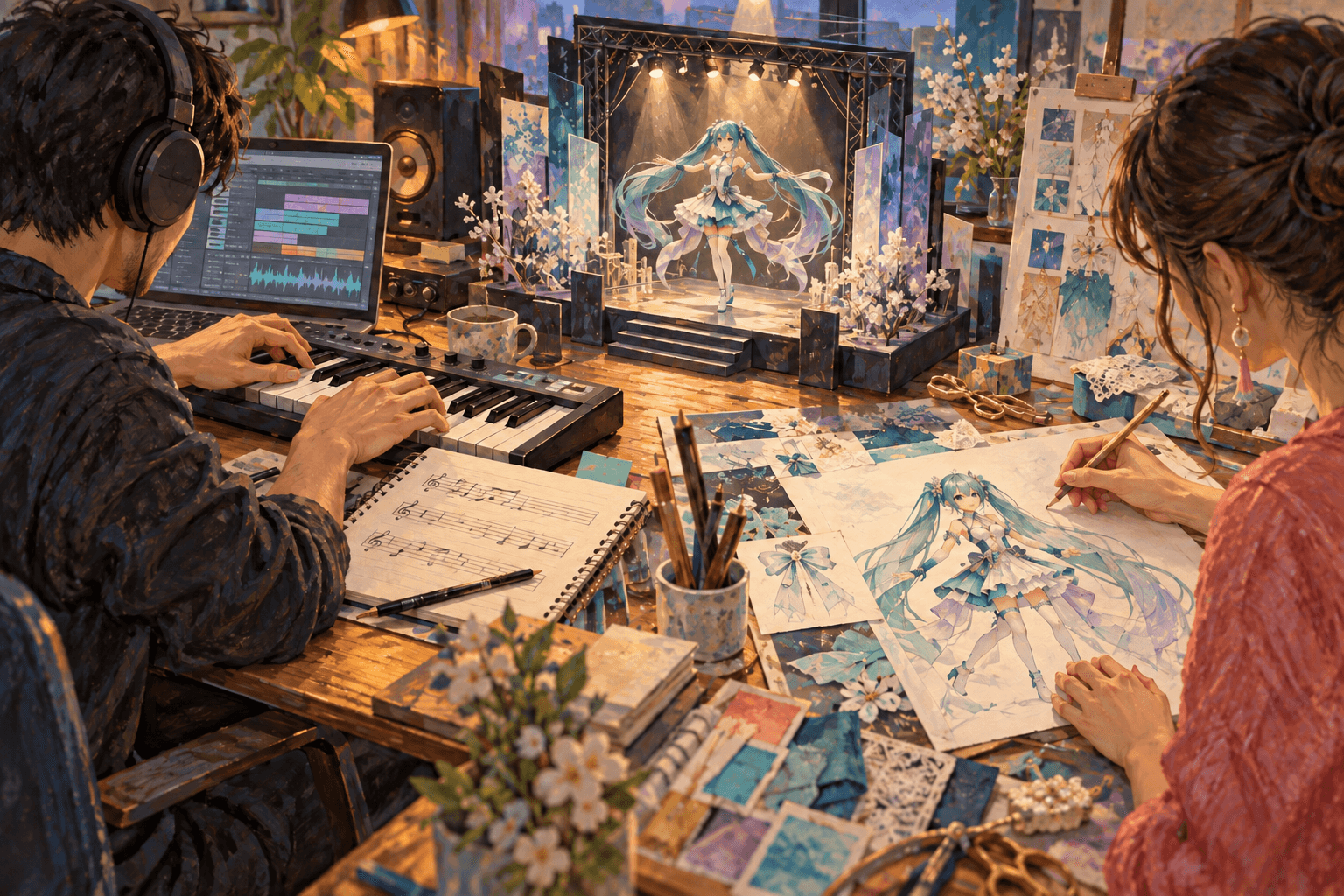
The route from independent work to an official show is a remarkable part of Miku's appeal. A song and a visual idea can arrive from different people and become one performance.
There is paperwork at that meeting place. The song competition's rules said that rights to the grand-prize submission would transfer to Crypton upon selection. The costume rules likewise specified a transfer of copyrights and related rights, and allowed adjustments for the final three-dimensional model. The invitation to contribute was real. So was the company's control over what happened to the selected work.
These terms don't tell us how either winner felt about the exchange. They do make “the fans own Miku” an inadequate description. Crypton's broader character-use guidelines distinguish noncommercial, unpaid derivative activity under the Piapro Character License from other uses. Piapro Link offers a route for certain small-scale, non-profit activities involving payment; it isn't a blanket commercial license. Permission to create, credit for a contribution, and ownership of the resulting rights are different things.
It is possible to celebrate a creative opening while reading its conditions. In fact, the closer we look at what people contribute, the harder it becomes to treat those conditions as a dull footnote. Someone composed the melody. Someone designed the clothes. Their work survives inside a performer whose name may be the only one a casual observer knows.
Jem's makers faced their own separation between authorship and ownership: Marx's account describes commissioned work within somebody else's property. The arrangements differ, and the available evidence doesn't support a clause-by-clause comparison of the original television contracts with Miku's contest rules. What they share is the distance that can open between the people who give a character meaning and the organization that controls the character.
Even the hair has to be performed
The costume doesn't leap from a winning drawing onto the stage by itself. In a Japanese interview published by CGWORLD in 2026, MARZA's production team described adapting the “M@GICAL☆CURE! LOVE ♥ SHOT!” outfit for Miku's model. The team adjusted the skirt length, enlarged the shoes, and loosened the jacket to find the right balance. For choreography in which Miku flicks her twin tails with her hands, simulation was combined with manual animation so that the hair moved with the gesture.
That last detail is a useful antidote to the idea that a virtual performer simply appears when the machine is switched on. A hand meets a lock of hair, and people have to decide how the encounter should look. The effect depends on a judgment about timing and weight, the same sort of judgment by which an animator persuades us that a drawing has noticed something or wants to move.
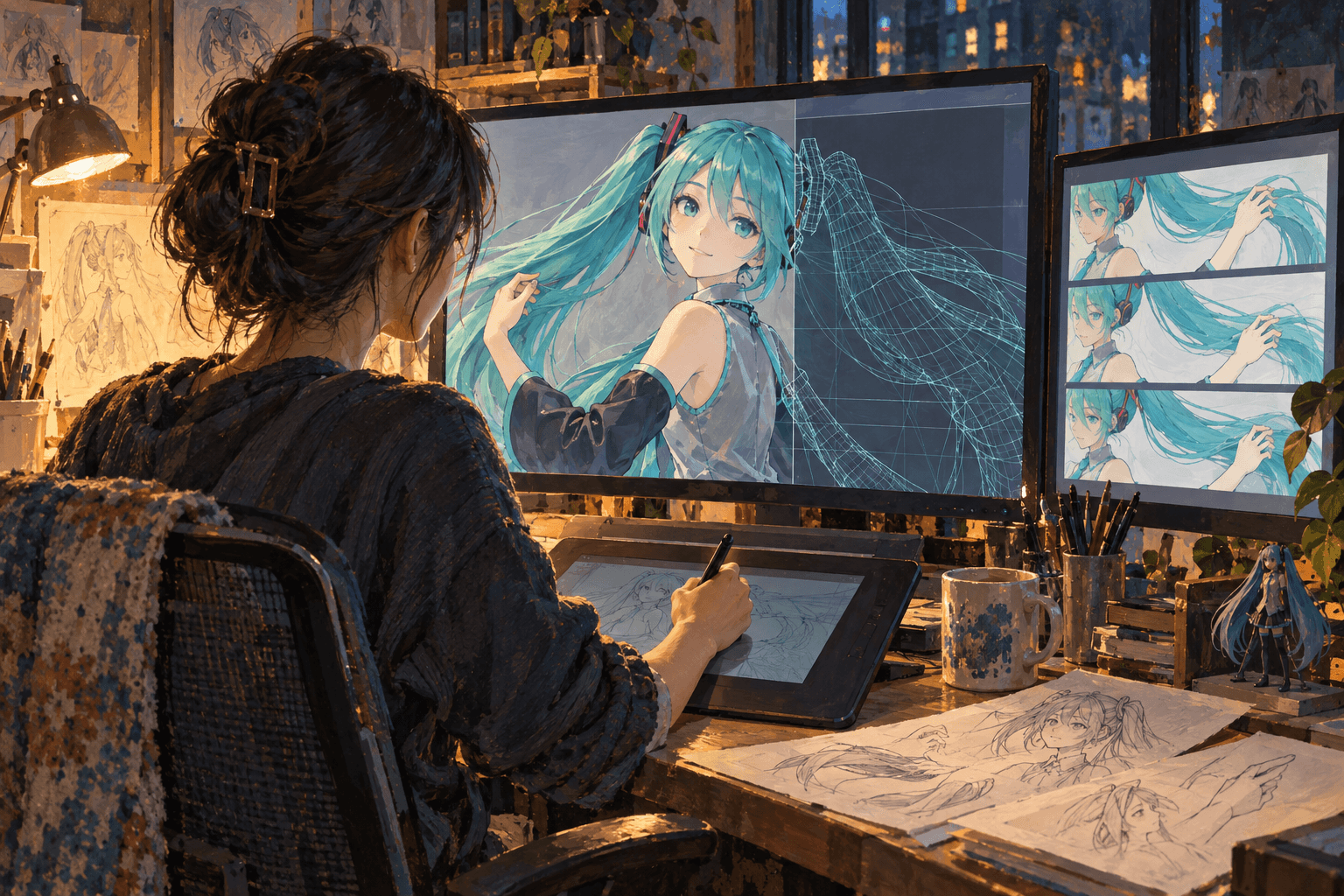
Calling Miku a hologram barely begins to describe that work. Her visible body is one part of a performance assembled from a song, a synthesized voice, visual design, animation, staging, musicians, and an audience prepared to recognize her. There is no single technical trick that explains everything we see and hear.
The word “virtual” can make those people sound less present than they are. It can encourage a search for the absent real singer, as though the backstage door ought to reveal one person who has been doing the whole thing. Miku's credits offer a different kind of discovery.
Jem lets us enjoy the promise that the dazzling public woman and the private one are ultimately the same. Miku asks us to become comfortable with a singer whose unity doesn't depend on that promise. Yet the comparison brings us back to a familiar habit in pop: the spotlight makes many people's choices appear to originate in one face.
Look again at the face, then at the credits. There may be no Jerrica waiting behind Miku. There are plenty of humans worth meeting.