
Four people are preparing a surprise. One is hiding a cake, another is trying to light the candles, a third is watching the door, and the person who should be helping is answering a phone.
This scene is invented, but its problem is real enough to picture: you cannot look at everyone equally at once. The scene needs to let you understand the group while choosing which action deserves your attention now.
That choice is not made only by cutting to whoever speaks. A person can become important by moving, becoming still, entering an open part of the frame, or reacting while someone else continues talking. A crowded scene becomes readable when the image gives relationships enough structure for a change in attention to mean something.
First, give the audience a usable room
Yale’s film-analysis guide describes establishing and reestablishing shots as ways to make spatial relationships understandable. Its account of continuity editing also explains how relationships between shots can help viewers follow an action. These are descriptive tools, not instructions that every scene must begin with the same wide shot. 1
For our fictional party, the useful information is modest: the cake is near the table, the watcher can see the entrance, and the distracted person is not looking where they need to look. We do not need a complete architectural survey.
An establishing view might supply those relationships together. Alternatively, several carefully connected shots could let us build the room gradually. The important result is that a later glance toward the door has somewhere to go in our understanding.
Without that relationship, a glance may still look expressive, but its immediate significance is harder to read. Is the person checking the entrance, looking for help, or reacting to somebody behind the camera? Uncertainty can be intentional. It should not be mistaken for suspense merely because something is unclear.
Staging is not the same as keeping everything in focus
Yale’s discussion of mise-en-scène distinguishes arrangements of figures in depth from the focus choices through which those figures are photographed. Placing people at different distances and keeping those distances sharply visible are related possibilities, but they are not the same decision. 2
Imagine the cake close to us, the candle-lighter behind the table, and the watcher near the distant door. The arrangement gives each action a place. The camera could then make one region more visually prominent, or invite attention to travel among several regions.
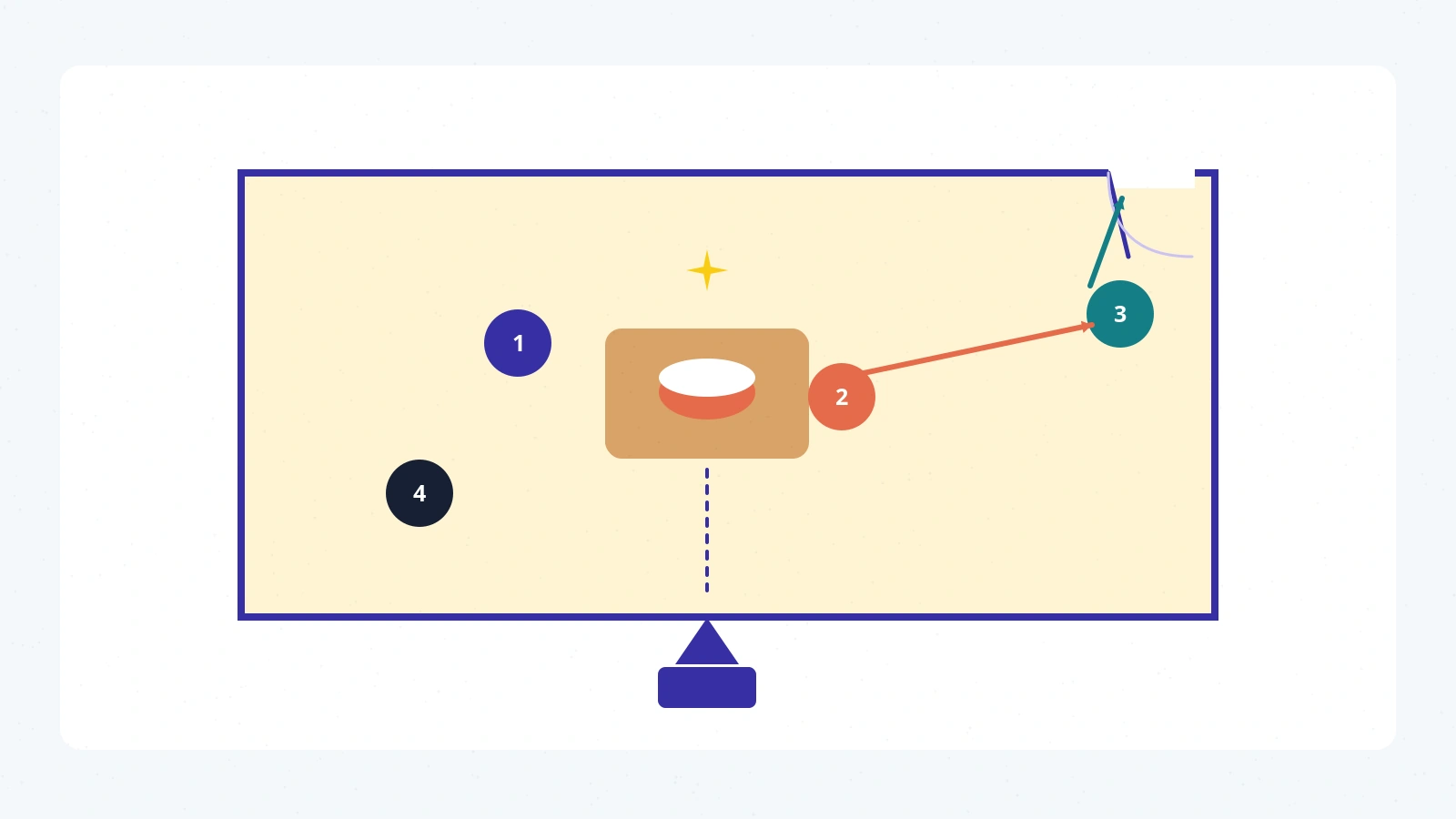
Our supporting graphic is a fictional overhead sketch, not a reconstruction of a real production. It shows why a group need not be arranged in a straight line to be understandable. The relationships matter more than placing every face at the same distance.
A scene can also make overlap useful. A person hiding the cake behind another person might turn the obstruction into the joke. What would be a visibility problem in one moment becomes the action itself in another.
Let movement change the hierarchy
Suppose everyone in our scene begins equally busy. The phone rings. Instead of cutting immediately, imagine that three people stop while the fourth continues moving. Attention can shift toward the movement because the pattern around it has changed.
Now reverse the example: everyone keeps moving except the watcher, who becomes still at the door. The stillness may become conspicuous against the activity. There is no universal rule that motion always wins. Contrast is doing the work in both sketches.
This is a viewing exercise, not an empirical ranking of what every audience will notice. The exact effect would depend on framing, performance, light, sound, and timing. A useful description names those relationships rather than saying only that a director “draws the eye.”
Ask what changed and what it changed against. The answer may be a gesture, a new gap between bodies, or the sudden disappearance of an object that had anchored the composition.
The person not speaking can carry the scene
The candle-lighter announces that everything is ready. Behind them, the watcher sees someone approaching. If the image lets us notice that reaction before the speaker does, the audience acquires a different position within the scene.
Cutting immediately to the speaker would produce another emphasis. Holding the group together could let the spoken confidence and the unspoken alarm coexist. Neither option is automatically more sophisticated. They offer different experiences of the same fictional event.
This is one reason ensemble scenes are interesting beyond dialogue delivery. A line can be one character’s action while another character’s response becomes the point. A listener’s face, posture, or interruption can revise how the line lands.
Be cautious about attributing the effect to one department. Actors, direction, cinematography, production design, sound, and editing all contribute to what survives on screen. A frame is a shared result, not a signature that allows us to identify every individual decision-maker by sight.
Planning can leave room for the actual scene
The American Society of Cinematographers’ report on Steve Yedlin’s discussion of Knives Out describes his collaboration with Rian Johnson and their use of storyboards as a conceptual framework. That is evidence about their planning process. It is not permission to invent shot-by-shot explanations of scenes we have not analyzed. 3
The distinction is useful when looking at any polished ensemble scene. Its clarity may feel effortless, but an account of planning can reveal work that the finished image conceals. Equally, a storyboard should not be mistaken for a guarantee that every planned relationship appears unchanged in the finished film.
For our party example, a drawing might establish the door, cake, and eyelines. The actual performers could discover a useful pause or a better way to pass an object. The scene would still need to preserve enough relationships for the audience to follow the change.
Planning and responsiveness need not be opposites. A clear underlying structure can make a small variation easier to understand.
Reorient when the relationships change
Eventually, someone opens the door. Our original arrangement no longer tells the whole story. A new person has entered; somebody may have moved; the cake may be visible from a different angle.
A wider view could renew our understanding. So could a well-chosen series of reactions and actions. What matters is whether the next important event has a readable context. Reestablishing the room is not necessarily a pause in the drama. It can be the moment the surprise becomes legible.
This also suggests a generous way to discuss unconventional staging. A scene that withholds orientation may want you to share a character’s confusion. The question is whether that withholding serves a particular experience, not whether it violates an imaginary requirement that every room remain diagrammatically clear.
On a later viewing of a familiar scene, track one thing: who becomes important without speaking. Notice what makes the shift possible. Was it a look, a movement, a cut, a sound, or another person getting out of the way?
You do not need to count every shot. A single well-understood change can reveal the craft of the whole encounter. The crowd becomes an ensemble when its members are not merely visible together, but arranged so that their different actions can become meaningful to one another—and to us.