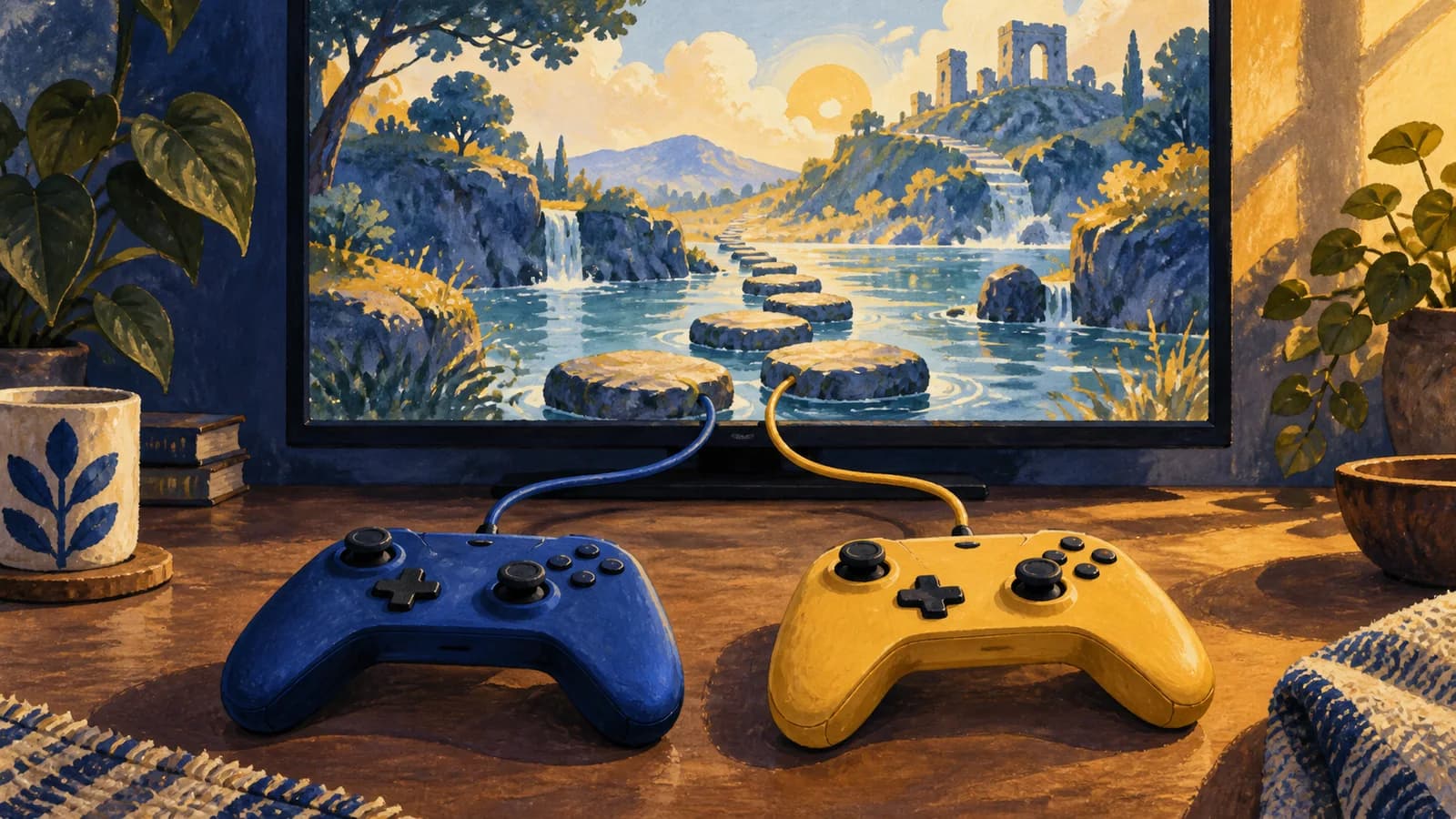
Two people can be in the same game while only one seems to be playing it. One solves the puzzle, chooses the route and gives instructions. The other follows, waiting for a moment when their own decision will matter.
That is not the only shape cooperative play can take. A game can distribute information, abilities or opportunities so that both people contribute. Players can also change the experience by deciding how they want to help one another.
The aim is not an identical number of button presses. It is a shared adventure in which neither person becomes an accessory.
Different tools can create a conversation
The publisher's description of Hazelight's It Takes Two presents the game as an experience built for two players, with connected character abilities that change across its levels. It supports local or online split-screen cooperation. 1
That premise suggests a useful design question: does having different tools make players depend on each other's judgment, or simply assign one person a repetitive supporting task?
The distinction requires looking at the actual activity. Two unlike actions can both be meaningful. Two equally complicated actions can still leave one player making every decision.
Rather than treating asymmetry as automatically good, ask what each player is invited to notice, attempt and communicate.
Help can be something a game lets you do
Nintendo's published Super Mario Bros. Wonder multiplayer description identifies several ways players can assist each other: sharing collected power-ups, riding on Yoshi and reviving a player who has become a ghost. 2
These are concrete examples of help being expressed through the game's actions. A contribution does not have to be defeating an obstacle first. It can be creating another opportunity for someone else to continue.
The official description establishes the features, not how every group experiences them. Carrying a friend through a difficult section might be welcome in one session and unwanted in another.
The useful question is whether assistance serves the person receiving it, rather than merely satisfying the helper's wish to move faster.
Ask before taking over
Imagine a fictional cooperative puzzle where one player has already spotted the solution. They could announce every step, offer a hint, or wait while the other person explores.
All three responses can be reasonable, depending on what the group wants. The mistake is assuming that speed is always the shared goal.
A brief question can settle the issue: do you want a hint, the answer, or a little more time? That keeps help from becoming an accidental replacement for participation.
This is an ordinary play suggestion, not a psychological rule. Players differ in how much direction they enjoy, and the same person may want different kinds of help on different evenings.

Meaningful roles need room to change
A game may give one player a movement challenge and another an observation task. That can create a satisfying partnership, but it can also become limiting if the same person is always assigned the same kind of work.
Where the game allows it, trying another role can change what each person notices. The player who usually explains may discover that a task feels different when timing an action rather than watching it.
Role swapping is not always possible, and it is not mandatory. The broader idea is to check whether the current arrangement still feels enjoyable to both people.
Being good at something does not mean a player wants to do only that for the entire session.
Shared success should be readable
Consider a hypothetical bridge that requires one player to hold a switch while another crosses. The supporting action can matter, but the presentation determines whether it feels like a contribution or a waiting room.
Can the switch-holder see what their action enables? Does the next section offer another responsibility? Is there a decision about timing, or only an instruction to remain still?
Those questions describe the structure of cooperation. They do not establish that a simple switch is inherently poor design. A quiet supporting action can be welcome between demanding sequences.
What matters is the pattern over time: whether both people get opportunities to make choices and recognize what those choices accomplish.
Failure belongs to the group too
Cooperation can become uncomfortable when every failed attempt turns into a search for the person at fault. A more useful conversation concerns what to try differently.
That might mean changing the timing, choosing another route, adjusting an available setting, or simply taking a break. None of those choices needs to become a judgment about who deserves to be playing.
A game's recovery rules matter here. When considering a title, look for information about checkpoints, retries and what happens when players become separated. Do not assume that the label “co-op” describes those details.
The practical question is whether the game's pace and recovery structure fit the experience your group wants.
Choose the relationship, not just the player count
Before starting, decide whether you want a relaxed shared outing, a demanding coordination challenge, or an evening of discovery. Then check the game's actual mode and platform requirements.
A useful recommendation is not necessarily the game with the largest number of cooperative features. It may be the one whose particular kind of cooperation gives both players a role they enjoy.
Look for the moment when your partner's contribution surprises you: a route you missed, a well-timed action, an unexpected rescue. That is when “playing together” becomes more than occupying the same screen.