Rumi Hiiragi, who voiced Chihiro in Spirited Away, describes an unexpected change in her response to Yubaba. In a Japanese interview published by Ghibli Park, she says that becoming a mother made the character’s intense attachment to her child newly familiar. Hiiragi remembers being frightened by Mari Natsuki’s powerful Yubaba performance when they were in the recording studio. The later recognition surprised her. An earlier fear and a later affinity belong to the same person’s account.
Her recollection offers a precise starting point for returning to a favourite animated film. A familiar figure can invite another question when a viewer approaches it from a different position. Recognising a quality in that figure need not settle every judgment about it. Hiiragi’s experience is hers; the interesting possibility for another viewer is to ask which relationship has become newly legible, and what remains difficult. A return can preserve an earlier response while making room for another one.
The question also becomes more useful when it has something concrete to follow. A colour choice, an altered room or a character’s stated aim gives attention a place to settle. Rather than treating a familiar film as a container from which a final meaning must be extracted, a return can examine how its parts sustain different questions. Production accounts are helpful here: they supply details against which an interpretation can be made more exact.
A film can contain its own return
Only Yesterday builds a relationship between different ages into its form. Studio Ghibli’s Japanese synopsis describes Taeko’s fifth-grade memories interweaving with her present at 27 as she moves towards a new way of living. The studio’s official credits identify Isao Takahata as writer and director, adapting the original work by Hotaru Okamoto and Yuko Tone. The past and present are already meeting within the film, before a viewer returns to it.
A Japanese colour study published in the Ghibli Museum foundation’s 2018–2019 annual report distinguishes the manga-derived memory section from the added adult section. The curator explains that the memories use a white-based treatment while preserving a sense of space. The adult figures pursue volume through low-saturation shadows whose placement is not tied to one strictly determined light source. This is an account of artistic construction, grounded in production materials and cited accounts, rather than a description of how human memory must work.
That difference suggests an interpretive possibility: the same story can give remembering and inhabiting the present different visual demands. A sparse remembered place may invite a question about what the image leaves available to be supplied; a more materially defined present may invite attention to how a body occupies its surroundings. These are ways of reading the described design, not diagnoses of Taeko or a rule that pale images always signify the past.
On a return, it can be useful to follow a transition before explaining it. What changes in the amount of visible space, the weight of a figure or the relation between a person and a background? Which change matters to the question currently being asked? Giving those details separate names prevents the broad word “nostalgia” from doing all the work. The exercise is to make a reading answerable to particulars, including particulars that resist it.

A room gives time somewhere to collect
Pixar’s production page for Toy Story 3 traces Andy’s room across the films: blue sky and white-cloud wallpaper give way to stars, then the third film’s wall objects and more subdued sunlight signal a teenager’s world and his approaching departure for college. The studio describes decoration and light as elements of a particular story problem. The room’s familiarity and its alterations can therefore be considered together.
A room offers an unusually manageable scale for looking again. A viewer can ask what remains in place, what has been replaced and what the light makes newly prominent. An object need not deliver a speech to participate in a change of circumstances. Equally, a change of decoration need not carry every possible meaning. Following a few details lets an interpretation explain why those details matter, rather than assigning significance to everything indiscriminately.
There is a practical distinction between noticing an object and deciding what it proves. First identify it, then consider how it sits among other objects and actions. An invented example makes the distinction clear: a packed box beside an open door could suggest departure, storage or an unfinished move. The surrounding arrangement has to do additional work. A close reading earns its account of time by attending to that arrangement; the object alone cannot settle it.
Departure changes more than the traveller’s position
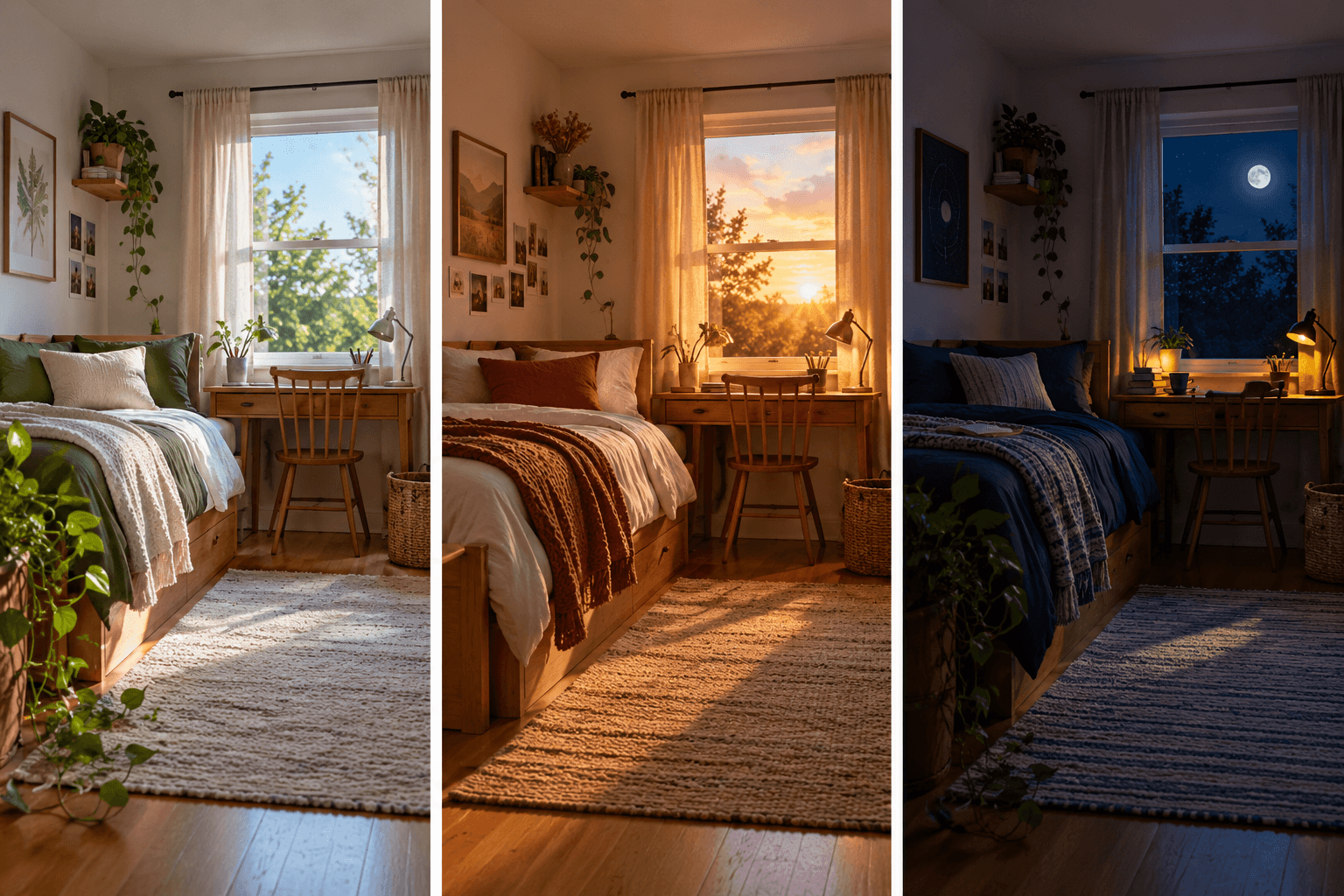
The room’s departure premise offers another reading question: whose uncertainty becomes prominent? Leaving can be considered from the position of someone anticipating a new place, or from the position of someone whose existing role is changing. The question shifts attention without requiring a different event. What looks like an opening from one position can become a problem of belonging from another. This is an interpretive frame for considering the premise, rather than a claim about how audiences of a particular age respond.
Such a reading becomes stronger when it keeps more than one position in view. Sympathy for a person facing change need not eliminate concern for those affected by it. Nor does concern for those remaining settle what the departure should mean. A return can ask how the story distributes attention between these positions: which concern gets time, which gets an explanation, and which has to be inferred. Those questions concern the work’s arrangements, not the viewer’s entitlement to a more mature verdict.
Happiness can be a character’s task
Pixar’s official Inside Out descriptions give Joy a definite goal: keeping Riley happy. The other emotions do not understand Sadness’s role, while Sadness herself wants to be more optimistic and helpful. The synopsis places their disagreement within Riley’s move following her father’s new job. The descriptions of her parents also give them circumstances to navigate. These are accounts of fictional characters and their situation, offering several positions from which to consider the same change.
One interpretive route is to follow the difference between a character’s aim and what that aim allows the character to recognise. A determination to make someone happy can be considered alongside the difficulty of understanding an unwelcome feeling. That does not require treating Joy as a villain or using the fictional emotions as a clinical diagram. It asks how an effort to help may shape attention, and what falls outside that effort’s preferred account of events.
For a return viewing, the useful question is specific: whose description of the difficulty is being accepted at a given moment? A scene might allow incompatible concerns to remain present, even if one character would prefer a quicker resolution. Following that possibility is a reading practice, not advice about managing another person’s feelings. The aim is to notice how a story makes room for disagreement, including disagreement between people who each want something to improve.

The people behind the image can enter the reading
New knowledge can also change the questions brought to a familiar work. In its Japanese institutional history, Studio Ghibli connects the success of Kiki’s Delivery Service with debate about staff conditions and recruitment. It records that, during Only Yesterday’s production, staff became regular, full-time employees and an animation-trainee system and regular recruitment began in November 1989. This is the studio’s own retrospective account of an organisational change. It is not a measurement of every worker’s experience.
That history places another kind of continuity beside a film’s images: the continuing work of people whose conditions and training have to be organised. Knowledge of a workplace does not replace an encounter with a drawing. It can give the viewer a further question about the skills and arrangements that allowed the drawing to reach the screen. Looking at a finished image and asking who made its particular choices can be complementary activities.
Credits are a practical place to begin that inquiry, because different tasks deserve different names. Colour, background design, movement and production organisation are not interchangeable contributions. A source that explains one of them can make an account of the work more precise. The value of research lies partly in knowing its reach: a curator’s discussion of shadows supports a discussion of colour decisions, while an institutional history supports a discussion of the organisation it records.

Keep the next question small enough to test
A return to an animated film need not set out to explain everything that has changed since the last encounter. Choose one relationship, one object or one formal decision and follow it. Ask what the work supplies for the reading, what comes from a production account, and what the interpretation itself is adding. Those distinctions leave room for surprise. They also make it possible to revise a conclusion when a detail refuses to fit.
Hiiragi’s account began with an affinity she had not expected. The examples here offer several other places to look: an image’s treatment of time, a room’s changing objects, competing accounts of care and the work behind a finished surface. None requires a viewer to abandon what was once moving or frightening. The next encounter can end with a more exact account of one detail, and with a question that remains open enough to accompany another return.