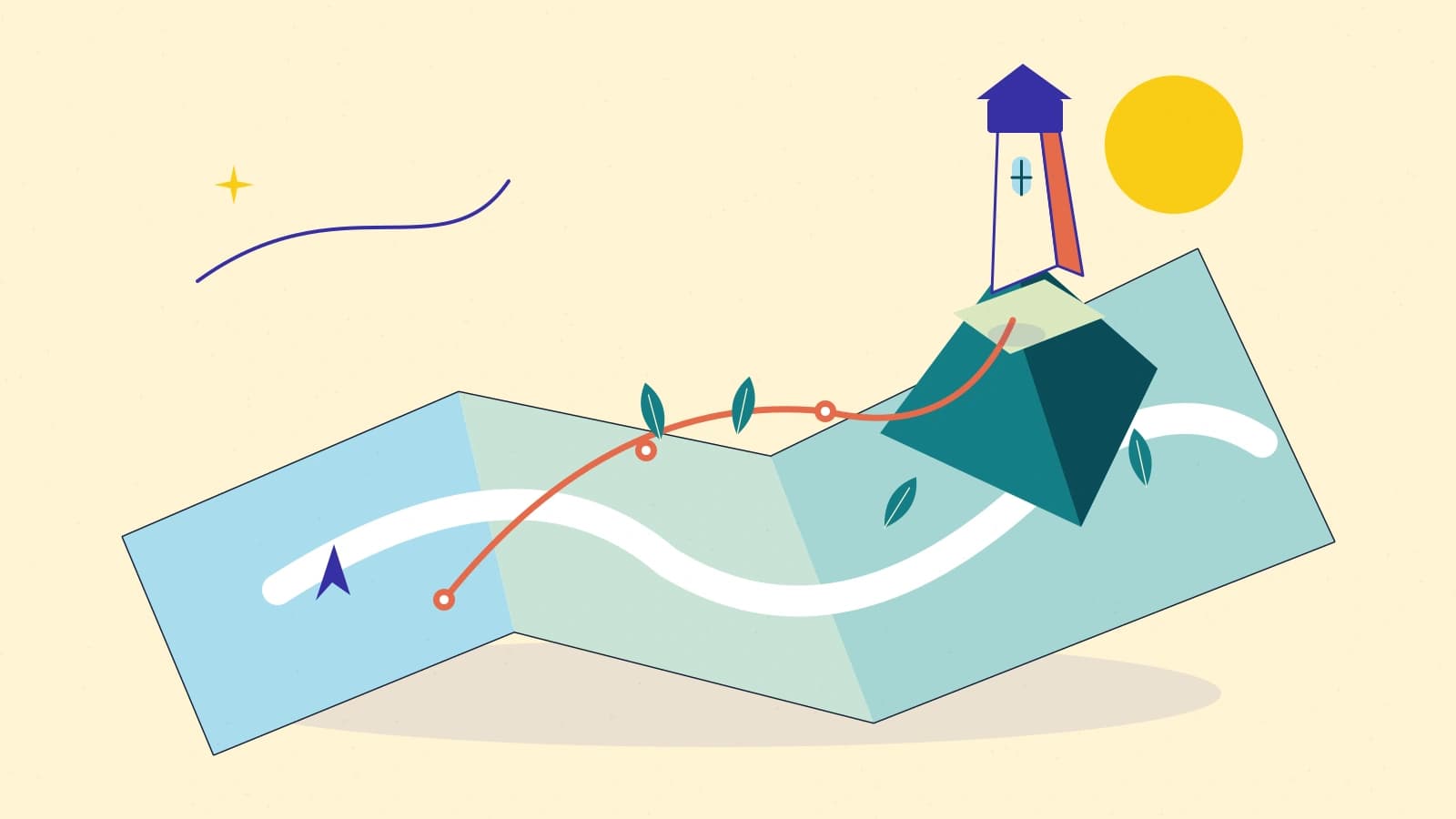
Being lost and being curious can feel similar for a minute. Both involve an unanswered question. After that, they may diverge. One question is “What is over that ridge?” The other is “Am I even going toward the place I was trying to reach?”
A game does not have to keep both questions unanswered to reward exploration. Knowing your position need not tell you what waits at a destination. Understanding the route need not reveal the view. A map can remove uncertainty that is wearing you down while leaving uncertainty that makes you want to continue.
The interesting design problem is not how little assistance a player can tolerate. It is which information should be clear, which discoveries should remain open, and how much control the player has over that balance.
Direction can live inside the world
In Sucker Punch’s account of creating Ghost of Tsushima, environment art lead Joanna Wang describes the Guiding Wind: a way for players to summon a directional cue expressed through the environment. Wind makes navigation something you can perceive through movement in the world rather than only through a persistent interface arrow. The account also describes deliberate choices about environmental identity and visual noise. 1
The principle is worth considering without treating it as the correct solution for every player or every game. An environmental cue still has to be noticed and understood. What looks elegantly unobtrusive to one person may be difficult for another to distinguish from ordinary scenery.
For an invented island, picture a lighthouse visible above the trees. It can orient you without drawing a line across the ground. But the lighthouse alone does not tell you whether a river crossing is open, whether the distant cliff has a path, or whether your character can climb it.
That is the difference between an attractive landmark and a complete navigation system. A designer can choose to make some of those questions part of the adventure. The player should not have to assume that every missing answer is an intentional puzzle.
Position, route, and discovery are separate layers
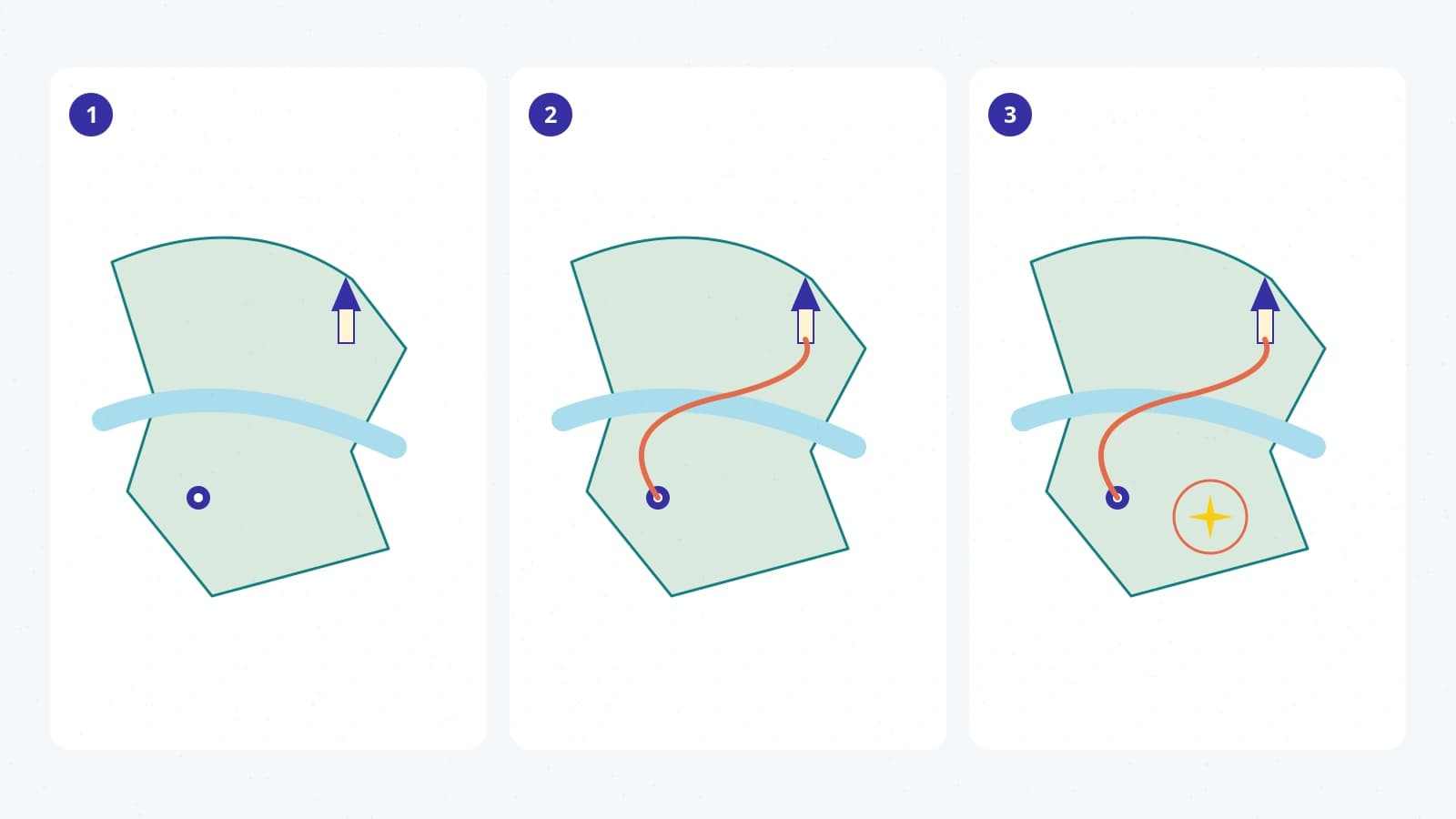
Let us build three hypothetical versions of that island map. The first marks only your current position and the coastline. The second adds a route to the lighthouse. The third also marks a hidden cove and explains what can be found there.
These maps disclose different things. The position marker helps you relate the drawing to your surroundings. The route reduces the work of finding a traversable connection. The cove marker exposes a discovery you might otherwise make yourself. Turning off all three at once is not the only way to have an exploratory experience.
For some evenings, a route line might be welcome because you want to arrive somewhere interesting before you stop playing. On another evening, following the coastline could be the whole pleasure. Neither preference establishes that you are a more authentic player.
The useful question is specific: what do you want to work out? You might enjoy choosing a route but dislike repeatedly checking which direction you face. Or you might want to solve environmental puzzles without searching for their entrances. Treating every kind of assistance as one indivisible “hand-holding” feature obscures those differences.
A setting can change the question you are solving
Guerrilla’s 2022 accessibility overview for Horizon Forbidden West describes choices between more exploratory guidance and guidance with markers, along with options such as persistent climbing annotations and configurable interface elements. Those are documented features of the release discussed in that article, not a promise that every platform or future version presents identical menus. 2
The distinction suggests a more useful way to read settings than looking for a single “immersive” preset. A climbing highlight concerns the interpretation of surfaces. A destination marker concerns direction. A quest reminder concerns your current purpose. You may want one without wanting all the others.
Imagine returning to the island after a week away. You remember the lighthouse, but not why you were heading there. A short objective reminder could restore context without exposing a single secret. Removing that reminder would not necessarily deepen the mystery; it might simply make the game harder to resume.
Good information can serve continuity. You can still choose the long way around once you remember what the short way was for.
Mystery needs enough stability to be noticed
Suppose the island’s map shows a small bridge, but you find only its supports. That discrepancy might be an invitation to investigate. Was the map old? Is the crossing elsewhere? Can another path take you around?
The discrepancy works as a possible story because something gives you a basis for noticing it. If every route, landmark, and position marker behaves unpredictably, the broken bridge becomes harder to distinguish from unreliable information.
This is an interpretation exercise, not a rule that maps must always be accurate. An unreliable map can be a deliberate device. The important distinction is between uncertainty you are invited to think about and uncertainty produced by an interface you cannot confidently interpret.
The same applies to symbols. An unexplained mark may be intriguing once. If you repeatedly forget whether a triangle means a viewpoint, a shop, or a place you have already visited, the symbol may be adding memory work rather than discovery. An optional legend can let the mystery remain in the world instead of relocating it to the icon set.
Clarity is also about what a screen makes you do
Xbox’s interface-context guidance asks developers to supply enough information for players to understand where they are in an interface and what actions are available. That guidance is broader than world maps, but it provides a useful companion question: can the player understand the interface before using it? 3
Applied to our hypothetical map, this means making its own operation understandable. Can you tell which layer is selected? Is a cursor over your character or over a distant marker? Will pressing the button pin a destination or initiate travel?
These are not the same questions as whether the island contains hidden paths. You can preserve a difficult journey while making its controls intelligible. Conversely, an enormous number of map options is not automatically helpful if their labels are cryptic or their effects impossible to preview.
A small amount of clear feedback can prevent the interface from becoming a second, unintended maze.
Choose the uncertainty you enjoy
For a practical experiment, begin with the information you need to feel oriented. Then remove one optional layer rather than turning the entire interface off. Keep location information but hide collectible markers, for example, where a game supports that combination.
After a short stretch, ask what changed. Did you notice the environment more? Did you discover something through observation? Or did you spend the time reopening menus and retracing a route you had already understood? Your answer can guide another adjustment without becoming a judgment about how anyone else should play.
None of this requires a game to accommodate every conceivable preference, and this article is not a hands-on assessment of the cited games. It is a way to describe the choices more accurately.
A satisfying map does not necessarily tell you everything. It tells you enough that the questions left over are questions you are glad to pursue. Finding your way and finding something unexpected can belong to the same adventure.