
A film can arrange a musical arrival around a fixed sequence of shots. A player may stand still, double back, take the long route, or spend another minute examining a corner. Music for an interactive experience has to contend with that freedom.
Sometimes the response is obvious: a new track begins when the situation changes. Sometimes you notice only that a familiar passage has acquired weight, brightness, or momentum. The melody still feels like itself, but the way it reaches you has shifted.
One rewarding way to listen to a game is to follow that seam. What changed in the play, what changed in the sound, and what stayed continuous enough to make the transition feel natural?
A transformation can have an arrangement of its own
In Nintendo’s developer discussion of Super Mario Bros. Wonder, Koji Kondo explains that becoming an elephant changes the background music’s arrangement. The interview also discusses the design of action sounds. Those are related parts of the soundscape, but a changed musical arrangement and a different jump effect are not the same thing. 1
That distinction is useful before any technical vocabulary enters the conversation. A sound effect can acknowledge a single event. Background music can respond to a condition that lasts. A transformation may call for both, each doing a different job.
The developer’s explanation establishes a design decision. It does not, by itself, tell us which software or playback technique implements that decision. We should not listen to a smooth transition and confidently announce an engine architecture that nobody has documented.
As readers, we can describe the audible relationship more modestly: the game presents a transformed character, and its creator describes a corresponding change in musical arrangement. That is already an interesting connection between what you do and what you hear.
The same tune can take a different route
Composer George A. Sanger describes an instructive prototype in an Audiokinetic article: six stereo versions of one tune, all at the same tempo but in different styles associated with different drivers. The intended interaction was to cross-fade toward the style of whichever driver led the race. His example concerns material for Monty Goulet’s unpublished Cosmic Highway project, not a claim about a released racing game we have tested. 2
The example shows how change and continuity can coexist. A musical identity can survive while its presentation changes. The player does not necessarily need a completely new melody to receive new information.
Imagine a different, entirely fictional game about delivering parcels through a floating town. One version of its theme uses a small, lightly played ensemble. Another uses the same underlying tune with broader, more forceful instrumentation. Switching between them might suggest that an ordinary delivery has become urgent.
That is a compositional possibility, not evidence that louder music means danger in every game. The response could be comic, celebratory, or deliberately misleading. The important relationship is the one the particular game establishes.
Two useful diagrams, not a guess at somebody’s code
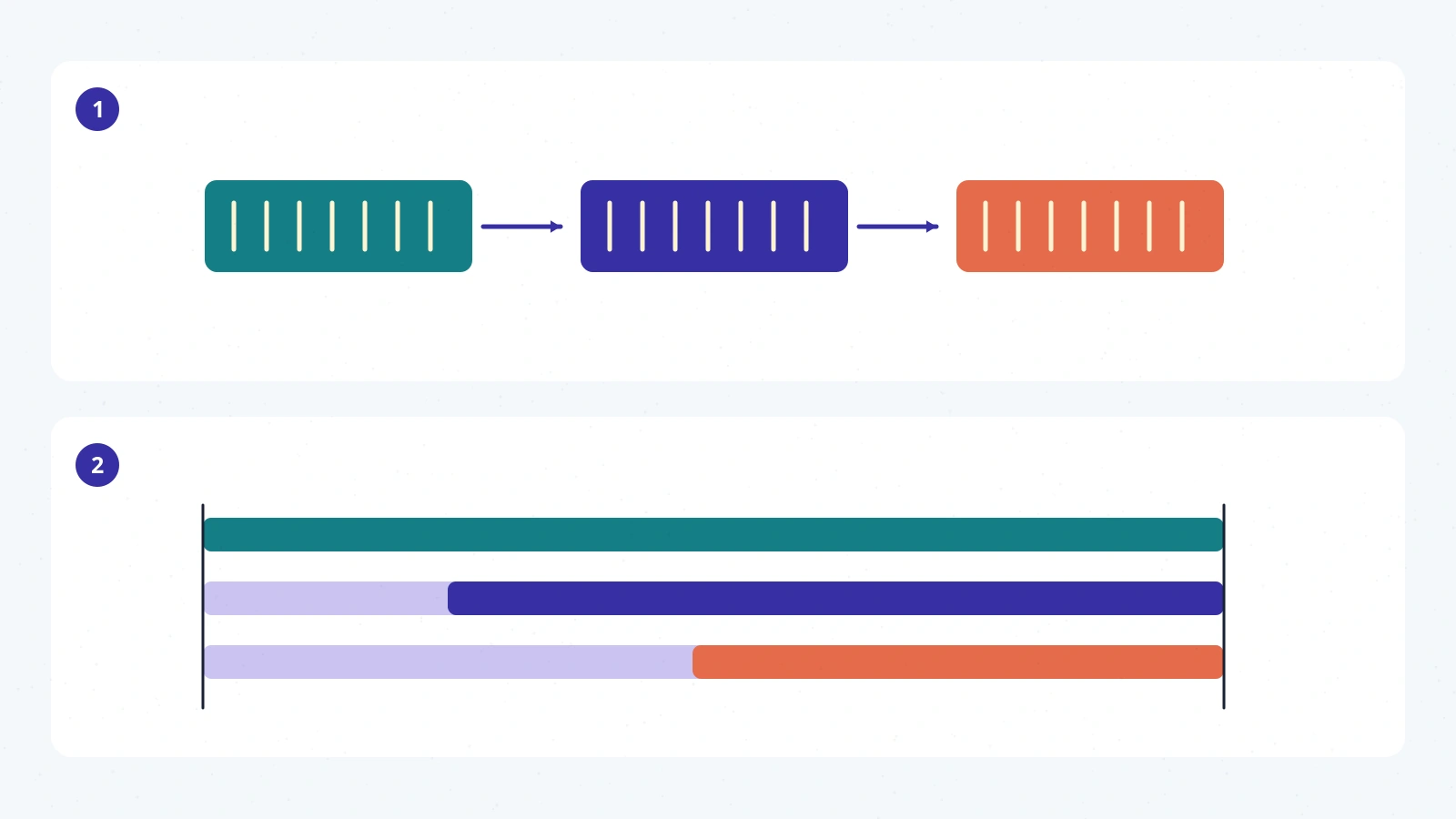
A simple way to imagine adaptive music is as a stack. A quiet underlying passage continues while additional musical parts enter or leave. A second way is as a route through sections: one passage leads into another when a condition is met.
Our supporting graphic illustrates those two conceptual models. It is not a screenshot of a production tool and does not describe the internals of Super Mario Bros. Wonder. Its purpose is to separate two questions a listener can ask: did the texture change around something continuing, or did the piece move somewhere else?
In the fictional delivery game, a drum part could join an existing passage when the courier begins to run. Alternatively, reaching a bridge could lead the music into a contrasting section. Combining both approaches is easy to imagine, too. None of these sketches establishes what will sound convincing until someone actually composes, implements, and hears the result.
Even a good concept can become tiring. If the courier briefly runs, stops, and runs again, a relentlessly immediate musical reaction might feel fidgety. The interesting artistic decision is not just what triggers a change, but how the music makes room for unstable human behavior.
A response does not have to be instantaneous
Suppose our imaginary drum part is meant to arrive with a new phrase rather than in the middle of a delicate pause. The game could acknowledge the action with a small sound immediately while the larger musical change waits for its own opening. This is a hypothetical arrangement choice, not a timing measurement from a cited game.
Thinking in those terms prevents a misleading expectation: that the best reactive music must chase every input as quickly as possible. Musical coherence and prompt feedback can have different requirements. A tiny acknowledgment can say “that happened”; a larger transition can say “we are somewhere else now.”
The reverse is also worth hearing. An abrupt interruption may be exactly the effect a scene needs. Smoothness is not always the artistic goal. A cut to silence can feel different from a gentle fade, even when both respond to the same fictional event.
What matters is whether the interruption belongs to the experience, not whether every transition hides its mechanism perfectly.
Listen to what stays behind
When a game’s score changes, attention naturally goes to the new material. Try listening for the element that remains. Perhaps a pulse continues beneath the transition, or an instrumental color returns in a new setting. Perhaps nothing is retained, and the discontinuity is the point.
Be careful with the conclusions. Hearing a recurring sound does not establish that the same audio file is playing. A composer may have written a related phrase, a performer may have recorded another version, or several elements may create the resemblance. The listening observation and the production explanation are different kinds of statement.
Nor does a score prove that a game knows your feelings. A system can respond to a location, state, or action without sensing whether you are personally excited or frightened. You may hear urgency while calmly organizing your inventory. That mismatch can be funny, distracting, or revealing about what the game treats as important.
The music is interpreting the situation according to a design. You are still free to experience the situation differently.
Make a small listening experiment
Choose a familiar, low-pressure section of a game you already have access to. Listen while moving, then while remaining still, then while crossing a boundary you can safely revisit. Avoid turning the exercise into an exhaustive hunt for every hidden musical state.
Describe what you actually notice before trying to explain it. “The percussion enters after I cross the bridge” is a more useful note than “the game switches to its combat layer” when you have no evidence for either combat or layering. An observation can be precise without pretending to know the implementation.
The developer accounts linked here provide examples and explanations, not a substitute for that listening. Sun Sun has not performed instrumented audio tests for this article.
A responsive score can make a game feel less like a sequence laid out in advance and more like a performance that is finding its shape around you. The pleasure is not only in recognizing the tune. It is in hearing how the tune makes room for your next move.